Local, CPU-Friendly, High-Quality TTS (Text-to-Speech) with Kokoro
ariya.io
July 7, 2026
3 min read
🔥🔥🔥🔥🔥
68/100
Summary
Kokoro enables high-quality text-to-speech (TTS) generation locally on a CPU without compromising privacy. The system operates on a machine with a GTX 1080 Ti, utilizing the GPU solely for local LLM inference.
Key Takeaways
- The Kokoro TTS model generates realistic speech using only CPU resources, achieving high quality without compromising user privacy.
- Kokoro supports multiple languages, including English, Mandarin, and Hindi, and offers around 50 distinct voices, primarily optimized for English.
- The TTS synthesis speed varies by CPU, with an AMD Ryzen 7 8745HS achieving synthesis in 1.5 seconds for a test paragraph.
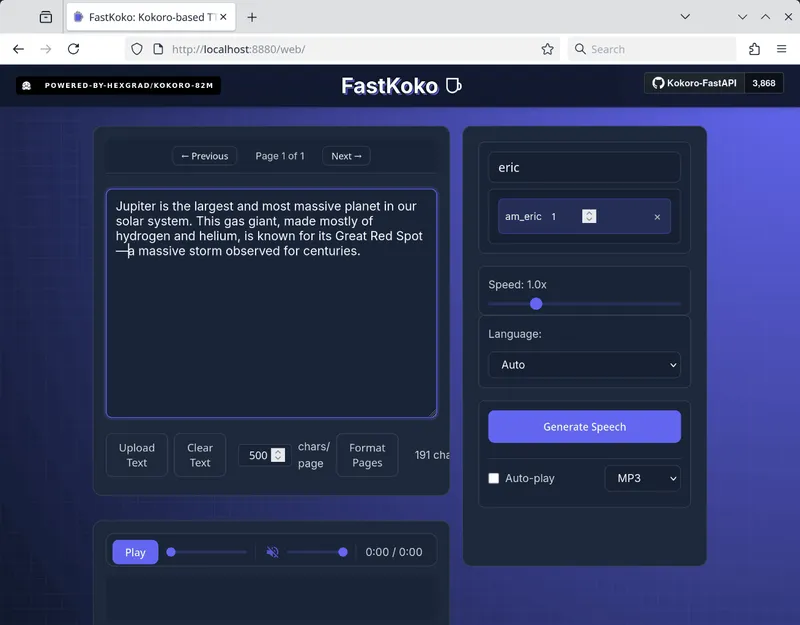
- Kokoro can be easily set up using a pre-made container image called Kokoro-FastAPI, which includes pre-downloaded voice models and a web UI for audio generation.
Community Sentiment
Positives
- Kokoro is a game changer for accessibility, especially for those without an NVidia GPU, making high-quality TTS more accessible to everyone.
- The ability to manually add IPA pronunciation guides is a standout feature, allowing for more accurate speech output and better user control.
- Running Kokoro on a GTX1650 for TTS has transformed my morning routine, letting me catch up on articles while driving — that’s a clever use case!
- Having a model that performs well on commodity hardware means democratization of TTS is within reach, which is incredibly exciting for the future of AI applications.
Concerns
- Kokoro struggles with short utterances, often mispronouncing single words, which could frustrate users who need precision in speech output.
- Some users point out that while Kokoro is capable, it lacks the robustness found in more established TTS solutions, particularly in specific scenarios.