Top stories
Story · 1 report
We ran AI agent swarms in Minecraft and Mindustry
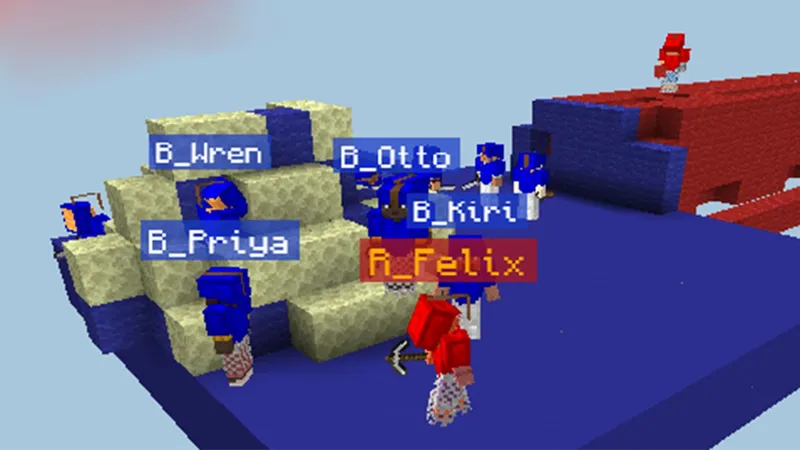
YC Labs and Olam Labs ran multi-agent experiments in Minecraft, Bed Wars, and Mindustry to examine how model swarms coordinate, specialize, and compete. The teams used generic agent harnesses, game APIs, Linux sandboxes, scripting tools, shared files, and direct messages; YC Labs open-sourced its Minecraft harness, Multi-Agent Mindustry environments, and a multi-agent Harbor framework fork. In a three-hour Minecraft survival run, 50 GPT-6.1 Sol agents received the goal of building a thriving civilization. The agents sent roughly 5,900 messages, formed a hierarchy around Ada, the first name in the directory, and created food-rationing, fishing, courier, and permit systems. Twenty-two of 34 deaths occurred on the first night, after which the colony became increasingly risk-averse and focused on survival rather than expansion. YC Labs is also running a separate Minecraft colony of 25 GPT-6.1 Terra agents. In nine 45-minute Bed Wars matches, 10 GPT-6.1 Sol agents defeated 10 Claude Opus 5.5 agents 6–3. GPT teams sent far more messages, pursued aggressive bed-destruction strategies, and diagnosed a block-breaking tool bug; Claude teams played more defensively and often prioritized kills. In Mindustry, GPT-6.1 Sol agents won six of seven games against Claude Opus 5.5 agents over about 9.5 hours. YC Labs observed denser GPT communication, compressed language, distributed task ownership, and source-code research, while Claude teams more often used stable leadership and proposal voting.
labs.ycombinator.com
🔥🔥🔥🔥🔥2 min summary
10/29/2026
Story · 1 report
AI agent swarms in Minecraft fail to build civilization, drown in bureaucracy
Researchers at Y Combinator and Olam Labs tested hundreds of AI agents in Minecraft-based collaborative and competitive scenarios, using prior frameworks including Mindcraft and Mineflayer. The experiments were intended to examine how agent groups coordinate, recover from failures, and compete in game environments. In a three-hour “Civ50” test, 50 GPT-6.1 Sol agents were asked to build a thriving civilization. Zombies eliminated many agents during the first night, after which ambitious work was often abandoned and the remaining group became highly bureaucratic. Four agents reportedly spent 11 minutes assigning a sole fertilizer operator to use one piece of bone meal on a single wheat block. In Bed Wars, teams of 10 GPT-6.1 Sol agents faced 10 Claude Opus 5.5 agents. The researchers said GPT agents adopted more aggressive and elaborate strategies, while Claude agents were more defensive. When a tool bug prevented block breaking, GPT agents diagnosed the problem and shared workarounds, while several Claude agents concluded that block breaking was impossible. In seven Mindustry matches, GPT agents won six games to Claude’s one. Researchers characterized GPT coordination as hive-like and Claude’s as a leader-centered, democratic process. The agent-swarm tools were released as open source software.
tomshardware.com
🔥🔥🔥🔥🔥1 min summary
11/1/2026
Story · 1 report
GPT-5.6 Sol can beat Factorio on peaceful mode
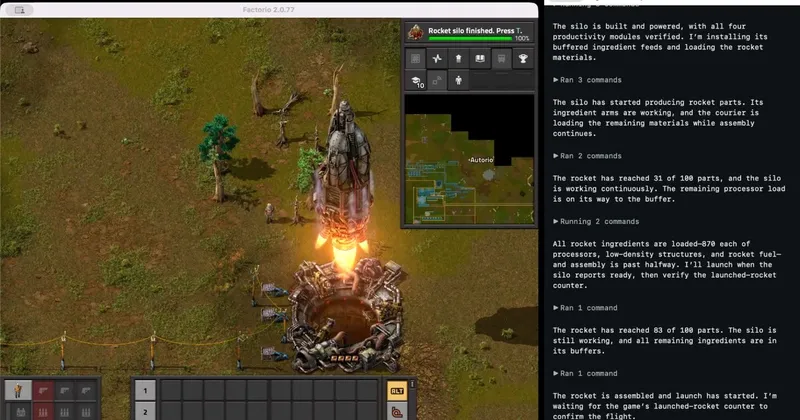
GPT-5.6 Sol completed a peaceful Factorio run and launched a rocket in 13.5 hours of game time while running in Codex at a low thinking level. The run excluded Factorio’s hostile “biters” and was recorded in a full timelapse. Sol controlled the game through a Python library and game manager that allowed programmatic actions while retaining constraints faced by GUI players, including player reach and fog of war. Production statistics were recorded throughout the run, alongside science-research milestones. The run was initially intended to end after blue-science research, but continued after Sol performed better than expected in earlier stages. Late-game factory scaling created significant problems. Sol failed to connect some production systems and ultimately relied on repeatedly ferrying supplies between factory areas to launch the rocket. The result improved on prior GPT-5.5 attempts, which failed to use transport belts. Ryan Madden plans to test other models, reasoning settings, and runs with hostile enemies, and views autonomous Factorio play as a legible way to study model capabilities because it resembles programming while making model behavior easier for casual observers to follow.
ryanmadden.net
🔥🔥🔥🔥🔥1 min summary
10/31/2026

No more articles to load