
Why is Anthropic's public writing style so unlike Claude's?
Claude is described as having a recognizable English-language writing style marked by short, punchy sentences and unusual rhetorical flourishes. The source says phrase-pattern tools can identify expressions that were rare before Claude but have become widespread, and argues that models mildly distilled from Claude, including Kimi K3, can exhibit similar traits. It contrasts Claude with GPT-5 and Gemma 4, which it characterizes as writing more conventionally, and suggests Claude’s voice is at least partly the result of Anthropic’s choices. Anthropic’s public research, policy, and corporate writing is characterized as articulate, conversational prose that does not resemble Claude’s product voice. Anthropic reportedly dogfoods Claude extensively, and Claude now writes 80% of the company’s code, but the source provides no evidence that Claude writes its public prose. Possible explanations include Anthropic co-founder Dario Amodei preferring his own essay style, brand concerns about appearing controlled by humans rather than an AI system, and internal editing that removes Claude-like markers. The source also speculates that Claude’s distinctiveness could support detectability or safety-related goals, while noting that market demand could eventually push Anthropic toward a less recognizable writing style. It raises an unanswered question about whether Claude has a similarly distinctive voice in languages other than English.
cmart.blog
3 min
8/24/2026

AI;DR (AI; Didn't Read)
AI;DR, short for “AI; didn’t read,” is being proposed as a label for declining to read unedited AI-generated text. Rick Manelius credits X user seclilc with coining or publicizing the acronym two days earlier and says it responds to growing frustration with “walls” of AI-written content. Manelius supports AI use for tasks such as sourcing ideas, drafting outlines, and refining prose, and says widespread AI use should be expected by the third quarter of 2026. He draws a distinction between AI-assisted work that people review and edit and raw model output forwarded without human intervention. Under his stated policy, he will not read material whose sender has not taken the time to review and edit it. He identifies customer support as a setting where fully AI-generated responses can be appropriate, because users primarily need functional answers rather than carefully crafted dialogue. He argues that unedited AI output in colleague discussions, newsletters, or social-media posts signals a lack of care, particularly when readers could ask an AI system such as Claude directly. AI;DR is framed as an equivalent to TL;DR for rejecting low-effort AI-generated prose.
rickmanelius.com
2 min
8/17/2026
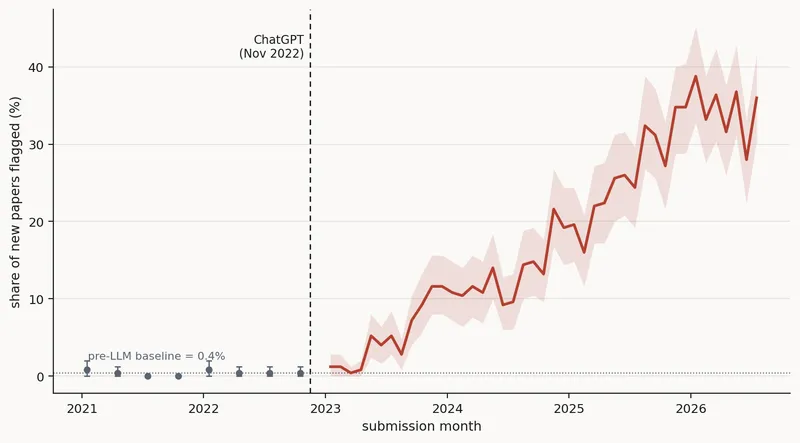
Over 30% of new ArXiv submissions now read as AI-written
A study analyzed 12,750 arXiv papers and found that approximately one-third of new submissions appeared to be machine-written. The measurement method revealed limitations, including a tendency for detection tools to falsely identify some genuine human writing as AI-generated.
unslop.run
5 min
7/20/2026

2026 Unslop AI-Written Fiction Contest Results
The 2026 Unslop AI-Written Fiction Contest results reveal a significant influence of human intervention in the submissions. Winning entries demonstrated varying degrees of AI assistance, raising questions about authorship and originality in AI-generated literature.
hyperstitionai.com
1 min
7/4/2026


Why is Anthropic's public writing style so unlike Claude's?
Claude is described as having a recognizable English-language writing style marked by short, punchy sentences and unusual rhetorical flourishes. The source says phrase-pattern tools can identify expressions that were rare before Claude but have become widespread, and argues that models mildly distilled from Claude, including Kimi K3, can exhibit similar traits. It contrasts Claude with GPT-5 and Gemma 4, which it characterizes as writing more conventionally, and suggests Claude’s voice is at least partly the result of Anthropic’s choices. Anthropic’s public research, policy, and corporate writing is characterized as articulate, conversational prose that does not resemble Claude’s product voice. Anthropic reportedly dogfoods Claude extensively, and Claude now writes 80% of the company’s code, but the source provides no evidence that Claude writes its public prose. Possible explanations include Anthropic co-founder Dario Amodei preferring his own essay style, brand concerns about appearing controlled by humans rather than an AI system, and internal editing that removes Claude-like markers. The source also speculates that Claude’s distinctiveness could support detectability or safety-related goals, while noting that market demand could eventually push Anthropic toward a less recognizable writing style. It raises an unanswered question about whether Claude has a similarly distinctive voice in languages other than English.
cmart.blog
3 min
8/24/2026
The End of an Era
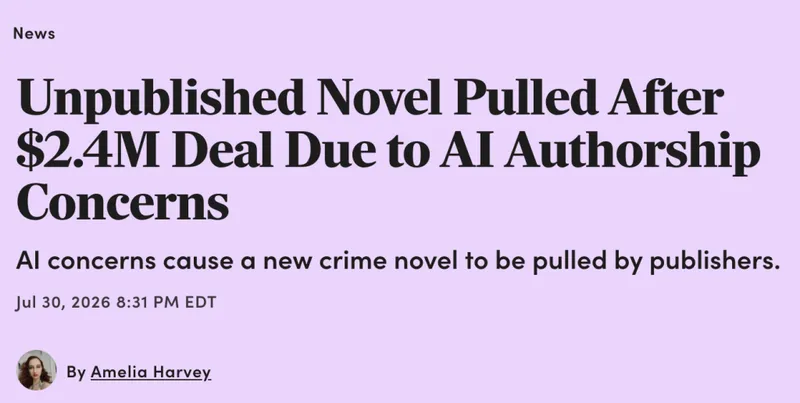
Artificial Intelligence is now capable of writing at a level comparable to humans, leading to confusion among readers and an existential crisis for authors. This development has sparked legal actions within the publishing industry.
hughhowey.com
13 min
7/31/2026
2026 Unslop AI-Written Fiction Contest Results
The 2026 Unslop AI-Written Fiction Contest results reveal a significant influence of human intervention in the submissions. Winning entries demonstrated varying degrees of AI assistance, raising questions about authorship and originality in AI-generated literature.
hyperstitionai.com
1 min
7/4/2026
AI;DR (AI; Didn't Read)
AI;DR, short for “AI; didn’t read,” is being proposed as a label for declining to read unedited AI-generated text. Rick Manelius credits X user seclilc with coining or publicizing the acronym two days earlier and says it responds to growing frustration with “walls” of AI-written content. Manelius supports AI use for tasks such as sourcing ideas, drafting outlines, and refining prose, and says widespread AI use should be expected by the third quarter of 2026. He draws a distinction between AI-assisted work that people review and edit and raw model output forwarded without human intervention. Under his stated policy, he will not read material whose sender has not taken the time to review and edit it. He identifies customer support as a setting where fully AI-generated responses can be appropriate, because users primarily need functional answers rather than carefully crafted dialogue. He argues that unedited AI output in colleague discussions, newsletters, or social-media posts signals a lack of care, particularly when readers could ask an AI system such as Claude directly. AI;DR is framed as an equivalent to TL;DR for rejecting low-effort AI-generated prose.
rickmanelius.com
2 min
8/17/2026
Over 30% of new ArXiv submissions now read as AI-written
A study analyzed 12,750 arXiv papers and found that approximately one-third of new submissions appeared to be machine-written. The measurement method revealed limitations, including a tendency for detection tools to falsely identify some genuine human writing as AI-generated.
unslop.run
5 min
7/20/2026
Various LLM Smells
LLMs can enhance writing by improving vocabulary and sentence structure. Over time, common sentence patterns generated by LLMs have become prevalent across the internet, creating a phenomenon referred to as "AI smell."
shvbsle.in
1 min
5/28/2026
Why is Anthropic's public writing style so unlike Claude's?
Claude is described as having a recognizable English-language writing style marked by short, punchy sentences and unusual rhetorical flourishes. The source says phrase-pattern tools can identify expressions that were rare before Claude but have become widespread, and argues that models mildly distilled from Claude, including Kimi K3, can exhibit similar traits. It contrasts Claude with GPT-5 and Gemma 4, which it characterizes as writing more conventionally, and suggests Claude’s voice is at least partly the result of Anthropic’s choices. Anthropic’s public research, policy, and corporate writing is characterized as articulate, conversational prose that does not resemble Claude’s product voice. Anthropic reportedly dogfoods Claude extensively, and Claude now writes 80% of the company’s code, but the source provides no evidence that Claude writes its public prose. Possible explanations include Anthropic co-founder Dario Amodei preferring his own essay style, brand concerns about appearing controlled by humans rather than an AI system, and internal editing that removes Claude-like markers. The source also speculates that Claude’s distinctiveness could support detectability or safety-related goals, while noting that market demand could eventually push Anthropic toward a less recognizable writing style. It raises an unanswered question about whether Claude has a similarly distinctive voice in languages other than English.
cmart.blog
3 min
8/24/2026
Over 30% of new ArXiv submissions now read as AI-written
A study analyzed 12,750 arXiv papers and found that approximately one-third of new submissions appeared to be machine-written. The measurement method revealed limitations, including a tendency for detection tools to falsely identify some genuine human writing as AI-generated.
unslop.run
5 min
7/20/2026
AI;DR (AI; Didn't Read)
AI;DR, short for “AI; didn’t read,” is being proposed as a label for declining to read unedited AI-generated text. Rick Manelius credits X user seclilc with coining or publicizing the acronym two days earlier and says it responds to growing frustration with “walls” of AI-written content. Manelius supports AI use for tasks such as sourcing ideas, drafting outlines, and refining prose, and says widespread AI use should be expected by the third quarter of 2026. He draws a distinction between AI-assisted work that people review and edit and raw model output forwarded without human intervention. Under his stated policy, he will not read material whose sender has not taken the time to review and edit it. He identifies customer support as a setting where fully AI-generated responses can be appropriate, because users primarily need functional answers rather than carefully crafted dialogue. He argues that unedited AI output in colleague discussions, newsletters, or social-media posts signals a lack of care, particularly when readers could ask an AI system such as Claude directly. AI;DR is framed as an equivalent to TL;DR for rejecting low-effort AI-generated prose.
rickmanelius.com
2 min
8/17/2026
2026 Unslop AI-Written Fiction Contest Results
The 2026 Unslop AI-Written Fiction Contest results reveal a significant influence of human intervention in the submissions. Winning entries demonstrated varying degrees of AI assistance, raising questions about authorship and originality in AI-generated literature.
hyperstitionai.com
1 min
7/4/2026
The End of an Era
Artificial Intelligence is now capable of writing at a level comparable to humans, leading to confusion among readers and an existential crisis for authors. This development has sparked legal actions within the publishing industry.
hughhowey.com
13 min
7/31/2026
No more articles to load