Latest stories
Story · 1 report
Harvey raised 500M for legal AI, I built the same and open sourced it
CaseCite is an Apache 2.0-licensed, self-hosted legal research and document-analysis platform that lets firms upload documents, search and chat over them, research cases and judges, review contracts, and draft documents. It stores document originals, search indexes, chat histories, and analyses on the firm’s deployment, while AI requests send questions and relevant document text to configured providers under the firm’s own API keys. Its research system combines semantic retrieval with BM25 keyword rescoring and source citations. Contract tools analyze documents, compare two to four contracts against a baseline, and export redlines or drafts. Drafting can use up to four selected knowledge-base documents and supports section-by-section generation for long documents. Case-law functions, including case views, judge analytics, citation checks, dockets, oral arguments, and trends, rely exclusively on CourtListener. Citation checking scans citing opinions for negative-treatment language and is not presented as a Shepard’s or KeyCite replacement. CaseCite supports OpenAI, Anthropic, and Gemini for language-model tasks, and OpenAI, Voyage, or Cohere for embeddings. Firms can host OpenAI-compatible chat and embedding services to keep document text within their own network. Uploaded originals and API keys use AES-256-GCM encryption, but derived text in vector chunks, chat history, analyses, Postgres, and Redis requires host-level disk encryption. CaseCite has no SOC 2, ISO 27001, or HIPAA certification.
github.com
🔥🔥🔥🔥🔥2 min summary
10/28/2026
Story · 1 report
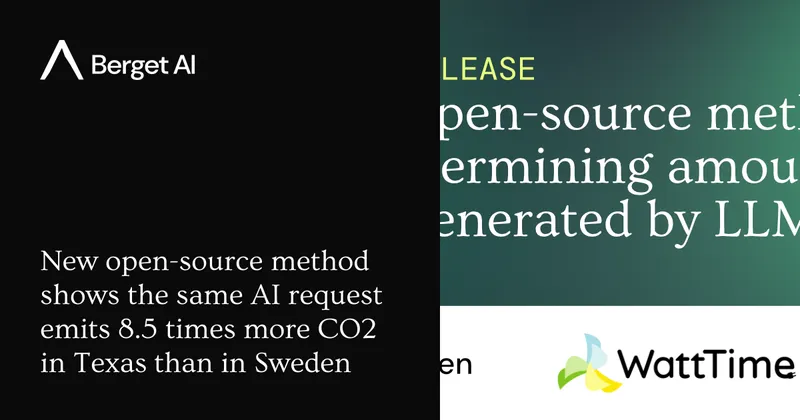
The same AI request emits 8.5 times more CO2 in Texas than in Sweden
Berget AI released an open-source method for calculating the carbon emissions of individual AI inference requests, developed with the Stockholm Environment Institute, WattTime and Klimatkollen. The Swedish AI infrastructure provider has added per-request emissions tracking to its customer console and published its calculator and methodology under an MIT licence. The method follows the Green Software Foundation’s SCI for AI specification and accounts for infrastructure energy use, cooling and hardware manufacturing, while excluding model training. Using identical hardware, Berget AI estimates that a typical Kimi K3 request emits 0.38 grams of CO₂e in Sweden, 1.6 grams in Ireland, 2.5 grams in Germany and 3.2 grams in Texas. The Texas estimate is 8.5 times Sweden’s, chiefly because of differences in grid emissions intensity. The example request uses about 4 Wh of energy, consists of 5,000 input and 387 output tokens, and is measured on a shared B300 deployment. Hardware manufacturing represents 89% of the Swedish result, while electricity represents 90% of the Texas result; the Texas request also uses about 6 mL of cooling water. The calculator applies location-based average grid emissions and can estimate any model and region. Berget AI said it will add marginal-emissions estimates next month and expand coverage to chip-manufacturing water and energy impacts. The company corrected earlier Ireland, Germany and Texas estimates on 21 October 2026 after reviewing its grid-intensity sources.
berget.ai
🔥🔥🔥🔥🔥2 min summary
10/23/2026
Story · 1 report
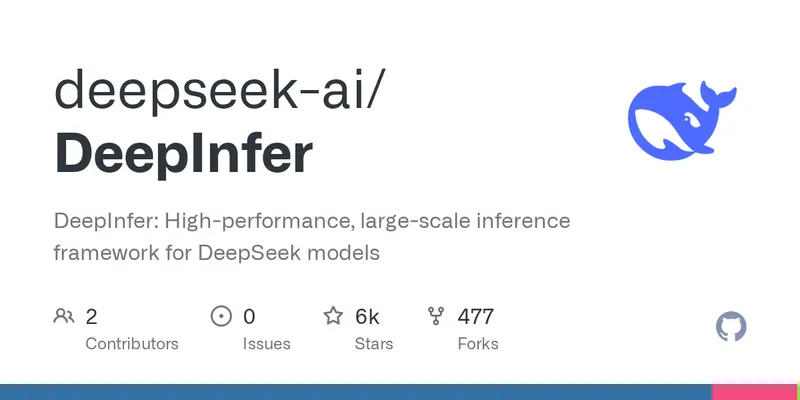
DeepSeek just open-sourced its inference engine
DeepSeek has open-sourced DeepInfer, the high-performance inference framework used in its large-scale production services. The release supports offline inference for DeepSeek-V4.1-Flash and includes optimized kernels and model and sampler runtimes. Its parallelism features include attention data parallelism, balanced context parallelism, mixture-of-experts expert parallelism, and expert parallel load balancing. DeepInfer uses FlashMLA, DeepGEMM, DeepEP, TileKernels, DeepSelect, and custom TileLang kernels. The framework supports DSpark and confidence-scheduled verification to accelerate decoding with draft tokens, decoder sliding-window-attention bounded replay to reduce prefill work, and asynchronous scheduling that overlaps CPU batch scheduling with device execution. It can provide batch-invariant inference and deterministic sampling on NVIDIA hardware, and it can constrain outputs with regular expressions, JSON schemas, or EBNF grammars. Supported hardware includes NVIDIA SM100 GPUs and Huawei Ascend 950 NPUs. DeepInfer requires Linux, GCC 13 or newer, and Python 3.12, plus CUDA 13 for NVIDIA or CANN 9.2 for Ascend. A complete serving system still requires components such as a KV-cache system, prefill/decode disaggregation, and load balancing across data-parallel replicas. DeepInfer is available under the Apache License 2.0.
github.com
🔥🔥🔥🔥🔥1 min summary
10/20/2026

No more articles to load