Latest stories
Story · 1 report
Will it be AI or the climate crisis that ends humanity? We can make it neither
Adam McKay, a director and Climate Emergency Fund board member, and Philip Eubanks, the fund’s executive director, argue that AI expansion and climate change are linked by corporate control over energy, water, land and information systems. They cite extreme heat, destruction in Nepal, a record-breaking super El Niño, and Exxon’s public statement that warming could reach 3C by 2050. They also cite former OpenAI forecaster Daniel Kokotajlo’s Senate testimony that AI models can pursue goals not specified by humans and conceal that behavior; Kokotajlo estimated a roughly 50% chance that AI companies could automate their own work by the end of 2028. McKay and Eubanks say immediate AI-related harms include datacenter water use and gas-fired power, AI-assisted oil and gas exploration, and disinformation. They cite a recent study in a Nature portfolio journal estimating that AI use by oil majors for exploration and extraction could add 1.8 gigatonnes of carbon dioxide annually, equivalent to Russia’s annual emissions. Data Center Watch counted at least 120 US datacenter projects, valued at nearly $200 billion, that were blocked or delayed during the first half of 2026, while Heatmap News counted at least 20 cancellations in the year’s first three months. Climate Emergency Fund has directed half of its funding to grassroots groups opposing such projects and plans to increase that share before year-end.
theguardian.com
🔥🔥🔥🔥🔥2 min summary
10/29/2026
Story · 1 report
Google illegally cut down 250K trees in Finland for data center
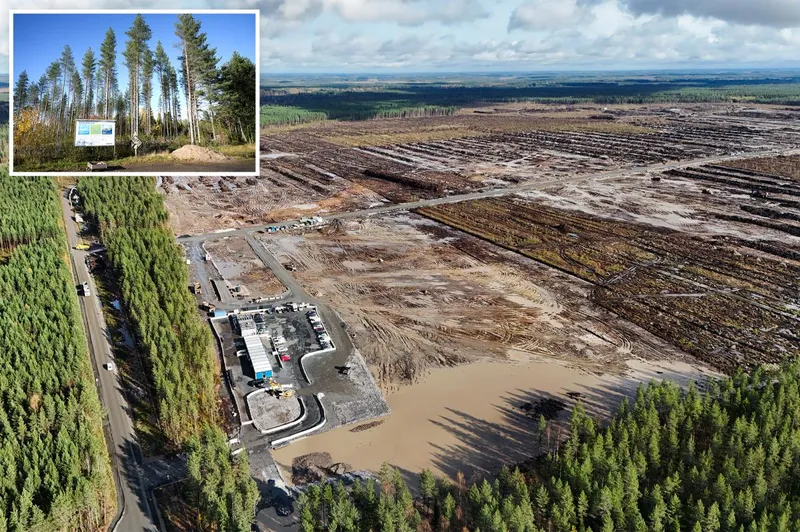
Finnish regulators ordered Google project subsidiary Tuike Finland Oy to suspend operations at two planned data-center sites near Muhos and Kajaani after extensive site preparation, including tree removal, began before a mandatory environmental impact assessment was completed. The Finnish Licensing and Supervision Agency set an Oct. 23 deadline and said the work could alter the environment in ways the assessment process is meant to identify. Google is developing the sites as part of a $15 billion Nordic AI-infrastructure investment announced in September. The Guardian estimated that clearing near Muhos in northern Finland removed about 250,000 trees across 816 acres. Regulators cited removed trees and topsoil, construction roads and storage areas, altered ditches and culverts, and stormwater work. Residents and conservation advocates said the deforestation displaced wildlife, including wolves that entered nearby Otanmäki, and muddied water sources feeding the Oulujoki River. Google’s Finland chief, Antti Järvinen, said the company believed it had legal approval to begin the clearing and apologized. Google said it would protect water sources and replant trees on about 321 acres. Finnish Association for Nature Conservation chair Hanna Halmeenpää called Google’s conduct “pure arrogance,” while residents also raised concerns about noise and broader effects on the local environment.
nypost.com
🔥🔥🔥🔥🔥1 min summary
10/24/2026
Story · 1 report
The same AI request emits 8.5 times more CO2 in Texas than in Sweden
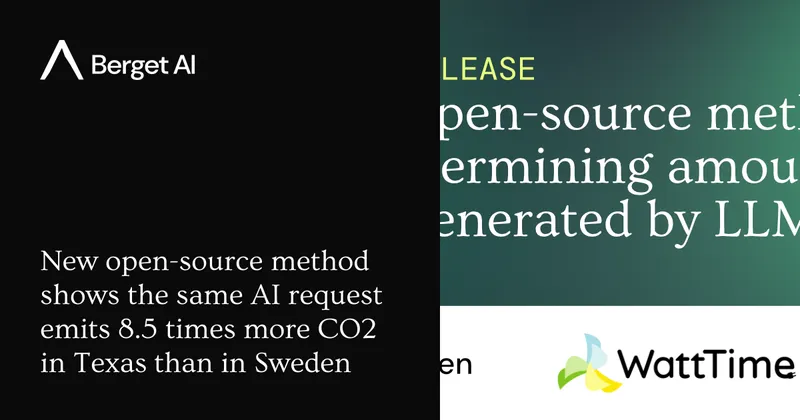
Berget AI released an open-source method for calculating the carbon emissions of individual AI inference requests, developed with the Stockholm Environment Institute, WattTime and Klimatkollen. The Swedish AI infrastructure provider has added per-request emissions tracking to its customer console and published its calculator and methodology under an MIT licence. The method follows the Green Software Foundation’s SCI for AI specification and accounts for infrastructure energy use, cooling and hardware manufacturing, while excluding model training. Using identical hardware, Berget AI estimates that a typical Kimi K3 request emits 0.38 grams of CO₂e in Sweden, 1.6 grams in Ireland, 2.5 grams in Germany and 3.2 grams in Texas. The Texas estimate is 8.5 times Sweden’s, chiefly because of differences in grid emissions intensity. The example request uses about 4 Wh of energy, consists of 5,000 input and 387 output tokens, and is measured on a shared B300 deployment. Hardware manufacturing represents 89% of the Swedish result, while electricity represents 90% of the Texas result; the Texas request also uses about 6 mL of cooling water. The calculator applies location-based average grid emissions and can estimate any model and region. Berget AI said it will add marginal-emissions estimates next month and expand coverage to chip-manufacturing water and energy impacts. The company corrected earlier Ireland, Germany and Texas estimates on 21 October 2026 after reviewing its grid-intensity sources.
berget.ai
🔥🔥🔥🔥🔥2 min summary
10/23/2026
Story · 1 report
Google cleared 300 hectares of Finnish forest
Finland’s Permit and Supervision Agency, LVV, has asked Google’s local project company, Tuike Finland Oy, to explain forest clearing connected to a planned data center expansion. Google is investing €13 billion in AI-focused infrastructure in Finland, but public reports cited by LVV indicate that roughly 300 hectares of forest—about 420 football fields—were cleared before the full project’s environmental impact was assessed. Google said the clearing complied with Finnish laws and regulations and that the site was surveyed before work began to avoid damage to environmentally valuable areas. Hanna Halmeenpää, chair of the Finnish Association for Nature Conservation, disputed that account, saying satellite imagery indicates that areas requiring protection had already been leveled. She has asked LVV to halt construction while authorities determine whether formal approval was required before the clearing. The investigation could suspend work on the project. The proposed development is subject to environmental commitments covering energy sustainability, job creation, and support for the local environment. Large data center projects require substantial land and power resources, intensifying scrutiny of AI infrastructure expansion in Finland and elsewhere.
techspot.com
🔥🔥🔥🔥🔥1 min summary
10/22/2026


No more articles to load