Qwen 3.8-Flash-Next releasing tomorrow (125B a6B)
ModelScope is a machine-learning model community that aggregates advanced models from multiple fields. The platform provides tools for exploring models, trying inference, training, deployment, and application development in one service. Users can discover, learn about, customize, and share machine-learning models through ModelScope. The service also supports collaborative development of an open-source model community.
modelscope.cn
1 min
8/25/2026
AirLLM 70B inference with single 4GB GPU
AirLLM enables 70B large language models to run on a single 4GB GPU without quantization, distillation, or pruning. Sparse MoE models allow for running larger models, such as the 405B Llama 3.1 on 8GB and the 2.8T Kimi K3 on under 4GB, by streaming one expert at a time.
github.com
7 min
8/3/2026
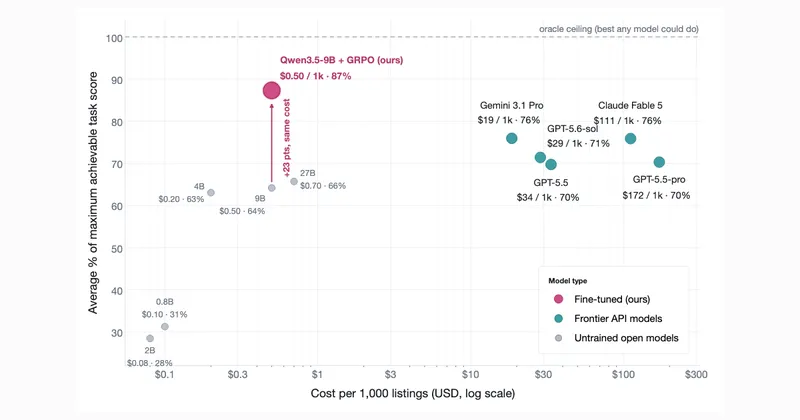
A $500 RL fine-tune of a 9B open model beat frontier models on catalog review
An open-source model combined with proprietary task data and reinforcement learning has been implemented in various real-world scenarios. Bridgewater Associates utilizes AI to analyze a continuous influx of documents to determine their relevance to investment strategies.
fermisense.com
2 min
7/28/2026

Ornith-1.0: self-improving open-source models for agentic coding
Ornith-1.0 is an open-source self-improving model for agentic coding, available in configurations of 9B-Dense, 31B-Dense, 35B-MoE, and 397B-MoE. It achieves state-of-the-art performance on coding benchmarks such as Terminal-Bench 2.1, SWE-Bench, NL2Repo, and OpenClaw by utilizing reinforcement learning for solution generation.
github.com
10 min
6/30/2026

AI Coding at Home Without Going Broke
AI coding at home can be done affordably by self-hosting, which involves purchasing hardware and running open-source models locally without ongoing costs. This method requires a significant upfront investment and may offer less powerful models compared to those from leading labs.
stephen.bochinski.dev
2 min
6/13/2026

Granite 4.1: IBM's 8B Model Matching 32B MoE
IBM has released Granite 4.1, a family of open-source language models designed for enterprise use, featuring three sizes and trained on 15 trillion tokens. The 8B model utilizes a dense architecture without mixture of experts (MoE) techniques and outperforms Granite 4.0-H-Small across various benchmarks.
firethering.com
9 min
4/30/2026

Kimi vendor verifier – verify accuracy of inference providers
The Kimi Vendor Verifier (KVV) project has been open-sourced alongside the Kimi K2.6 model to assist users in verifying the accuracy of their inference implementations. KVV aims to ensure that open-source models run correctly across different environments.
kimi.com
2 min
4/20/2026

LLM Neuroanatomy II: Modern LLM Hacking and Hints of a Universal Language?
Duplicating a block of seven middle layers in Qwen2-72B without weight changes or training produced a top model on the HuggingFace Open LLM Leaderboard. Since mid-2024, several strong open-source models have emerged, including Qwen3.5, MiniMax, and GLM-4.
dnhkng.github.io
20 min
3/24/2026

Sarvam 105B, the first competitive Indian open source LLM
Sarvam 30B and Sarvam 105B are open-source reasoning models trained from scratch on large-scale, high-quality datasets. The training was conducted in India under the IndiaAI mission, optimizing various aspects including tokenization, model architecture, and execution kernels.
sarvam.ai
30 min
3/7/2026
Qwen 3.8-Flash-Next releasing tomorrow (125B a6B)
ModelScope is a machine-learning model community that aggregates advanced models from multiple fields. The platform provides tools for exploring models, trying inference, training, deployment, and application development in one service. Users can discover, learn about, customize, and share machine-learning models through ModelScope. The service also supports collaborative development of an open-source model community.
modelscope.cn
1 min
8/25/2026
A $500 RL fine-tune of a 9B open model beat frontier models on catalog review
An open-source model combined with proprietary task data and reinforcement learning has been implemented in various real-world scenarios. Bridgewater Associates utilizes AI to analyze a continuous influx of documents to determine their relevance to investment strategies.
fermisense.com
2 min
7/28/2026
Ornith-1.0: self-improving open-source models for agentic coding
Ornith-1.0 is an open-source self-improving model for agentic coding, available in configurations of 9B-Dense, 31B-Dense, 35B-MoE, and 397B-MoE. It achieves state-of-the-art performance on coding benchmarks such as Terminal-Bench 2.1, SWE-Bench, NL2Repo, and OpenClaw by utilizing reinforcement learning for solution generation.
github.com
10 min
6/30/2026
Granite 4.1: IBM's 8B Model Matching 32B MoE
IBM has released Granite 4.1, a family of open-source language models designed for enterprise use, featuring three sizes and trained on 15 trillion tokens. The 8B model utilizes a dense architecture without mixture of experts (MoE) techniques and outperforms Granite 4.0-H-Small across various benchmarks.
firethering.com
9 min
4/30/2026
LLM Neuroanatomy II: Modern LLM Hacking and Hints of a Universal Language?
Duplicating a block of seven middle layers in Qwen2-72B without weight changes or training produced a top model on the HuggingFace Open LLM Leaderboard. Since mid-2024, several strong open-source models have emerged, including Qwen3.5, MiniMax, and GLM-4.
dnhkng.github.io
20 min
3/24/2026
AirLLM 70B inference with single 4GB GPU
AirLLM enables 70B large language models to run on a single 4GB GPU without quantization, distillation, or pruning. Sparse MoE models allow for running larger models, such as the 405B Llama 3.1 on 8GB and the 2.8T Kimi K3 on under 4GB, by streaming one expert at a time.
github.com
7 min
8/3/2026
Kimi K3 Now Available via Telnyx Inference API
Kimi K3, the first 2.8T parameter open-source model, is now on Telnyx Inference. 1M context window, native vision, configurable reasoning. Input $2.70/1M tokens.
telnyx.com
1 min
7/27/2026
AI Coding at Home Without Going Broke
AI coding at home can be done affordably by self-hosting, which involves purchasing hardware and running open-source models locally without ongoing costs. This method requires a significant upfront investment and may offer less powerful models compared to those from leading labs.
stephen.bochinski.dev
2 min
6/13/2026
Kimi vendor verifier – verify accuracy of inference providers
The Kimi Vendor Verifier (KVV) project has been open-sourced alongside the Kimi K2.6 model to assist users in verifying the accuracy of their inference implementations. KVV aims to ensure that open-source models run correctly across different environments.
kimi.com
2 min
4/20/2026
Sarvam 105B, the first competitive Indian open source LLM
Sarvam 30B and Sarvam 105B are open-source reasoning models trained from scratch on large-scale, high-quality datasets. The training was conducted in India under the IndiaAI mission, optimizing various aspects including tokenization, model architecture, and execution kernels.
sarvam.ai
30 min
3/7/2026
Qwen 3.8-Flash-Next releasing tomorrow (125B a6B)
ModelScope is a machine-learning model community that aggregates advanced models from multiple fields. The platform provides tools for exploring models, trying inference, training, deployment, and application development in one service. Users can discover, learn about, customize, and share machine-learning models through ModelScope. The service also supports collaborative development of an open-source model community.
modelscope.cn
1 min
8/25/2026
Kimi K3 Now Available via Telnyx Inference API
Kimi K3, the first 2.8T parameter open-source model, is now on Telnyx Inference. 1M context window, native vision, configurable reasoning. Input $2.70/1M tokens.
telnyx.com
1 min
7/27/2026
Granite 4.1: IBM's 8B Model Matching 32B MoE
IBM has released Granite 4.1, a family of open-source language models designed for enterprise use, featuring three sizes and trained on 15 trillion tokens. The 8B model utilizes a dense architecture without mixture of experts (MoE) techniques and outperforms Granite 4.0-H-Small across various benchmarks.
firethering.com
9 min
4/30/2026
Sarvam 105B, the first competitive Indian open source LLM
Sarvam 30B and Sarvam 105B are open-source reasoning models trained from scratch on large-scale, high-quality datasets. The training was conducted in India under the IndiaAI mission, optimizing various aspects including tokenization, model architecture, and execution kernels.
sarvam.ai
30 min
3/7/2026
AirLLM 70B inference with single 4GB GPU
AirLLM enables 70B large language models to run on a single 4GB GPU without quantization, distillation, or pruning. Sparse MoE models allow for running larger models, such as the 405B Llama 3.1 on 8GB and the 2.8T Kimi K3 on under 4GB, by streaming one expert at a time.
github.com
7 min
8/3/2026
Ornith-1.0: self-improving open-source models for agentic coding
Ornith-1.0 is an open-source self-improving model for agentic coding, available in configurations of 9B-Dense, 31B-Dense, 35B-MoE, and 397B-MoE. It achieves state-of-the-art performance on coding benchmarks such as Terminal-Bench 2.1, SWE-Bench, NL2Repo, and OpenClaw by utilizing reinforcement learning for solution generation.
github.com
10 min
6/30/2026
Kimi vendor verifier – verify accuracy of inference providers
The Kimi Vendor Verifier (KVV) project has been open-sourced alongside the Kimi K2.6 model to assist users in verifying the accuracy of their inference implementations. KVV aims to ensure that open-source models run correctly across different environments.
kimi.com
2 min
4/20/2026
A $500 RL fine-tune of a 9B open model beat frontier models on catalog review
An open-source model combined with proprietary task data and reinforcement learning has been implemented in various real-world scenarios. Bridgewater Associates utilizes AI to analyze a continuous influx of documents to determine their relevance to investment strategies.
fermisense.com
2 min
7/28/2026
AI Coding at Home Without Going Broke
AI coding at home can be done affordably by self-hosting, which involves purchasing hardware and running open-source models locally without ongoing costs. This method requires a significant upfront investment and may offer less powerful models compared to those from leading labs.
stephen.bochinski.dev
2 min
6/13/2026
LLM Neuroanatomy II: Modern LLM Hacking and Hints of a Universal Language?
Duplicating a block of seven middle layers in Qwen2-72B without weight changes or training produced a top model on the HuggingFace Open LLM Leaderboard. Since mid-2024, several strong open-source models have emerged, including Qwen3.5, MiniMax, and GLM-4.
dnhkng.github.io
20 min
3/24/2026
No more articles to load