Autoresearch on an old research idea
ykumar.me
March 23, 2026
6 min read
🔥🔥🔥🔥🔥
66/100
Summary
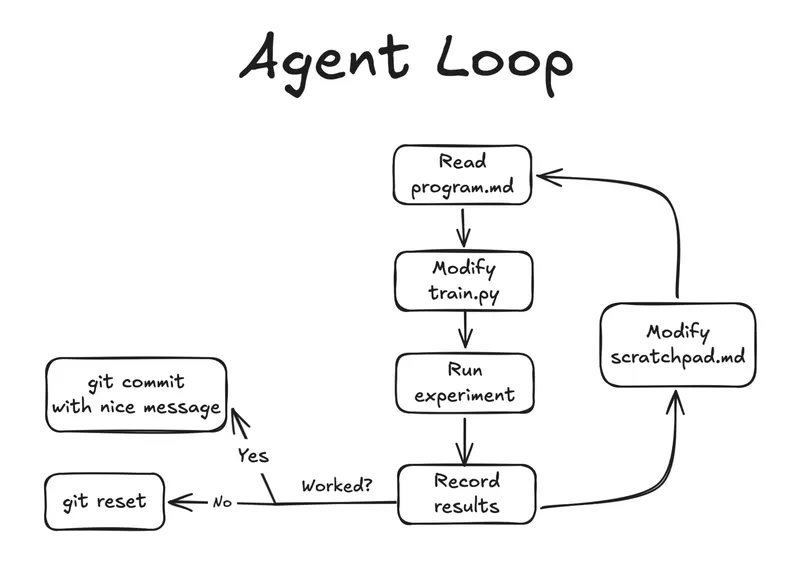
Karpathy's Autoresearch utilizes a constrained optimization loop with a large language model (LLM) agent. The author applied Autoresearch to legacy code from eCLIP while managing household tasks.
Key Takeaways
- Autoresearch is implemented as a constrained optimization loop where an LLM agent iteratively improves an evaluation metric by modifying a single file while following structured phases of exploration.
- The experimentation process involves a quick iteration cycle of hypothesizing, editing, training, evaluating, and committing or reverting changes, with each run designed to take around 5 minutes.
- The agent utilized the Ukiyo-eVG dataset, which consists of approximately 11,000 Japanese woodblock prints with bounding box annotations, to test the expert attention mechanism.
- The agent conducted 42 experiments, resulting in 13 committed changes and 29 reverts, significantly improving the evaluation mean rank during the process.
Community Sentiment
Positives
- Using LLMs to explore prior art can yield valuable insights, with even a small percentage of applicable knowledge being beneficial for learning and problem-solving.
- The structured trial and error approach of Autoresearch, despite its limitations, still provides a useful framework for optimizing research processes.
Concerns
- The reliance on hyperparameter tuning in Autoresearch raises concerns about its overall value, suggesting that the costs may not justify the benefits.
- Many recommendations from LLMs are often irrelevant or poorly maintained, which can lead to wasted resources and inefficiencies in real-world applications.
- The effectiveness of Autoresearch is heavily dependent on the quality of the evaluation metrics used, which can undermine the optimization process if they are inadequate.
Related Articles
Autoresearch: Agents researching on single-GPU nanochat training automatically
Mar 7, 2026
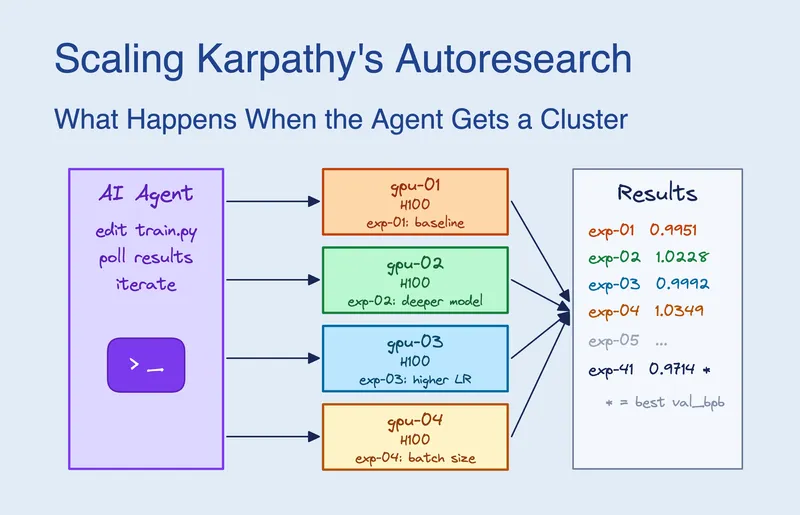
Scaling Karpathy's Autoresearch: What Happens When the Agent Gets a GPU Cluster
Mar 19, 2026
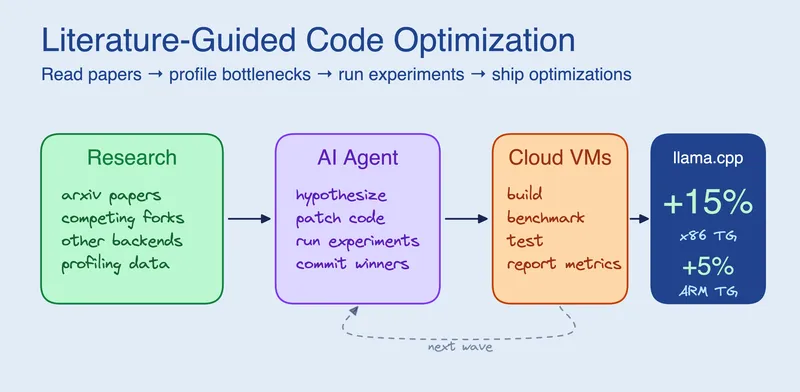
Research-Driven Agents: When an agent reads before it codes
Apr 9, 2026

Building for an audience of one: starting and finishing side projects with AI
Feb 17, 2026

Auto-research with codex: How I achieved a 232x Faster Kernel
Aug 15, 2026