Scaling Karpathy's Autoresearch: What Happens When the Agent Gets a GPU Cluster
blog.skypilot.co
March 19, 2026
12 min read
59/100
Summary
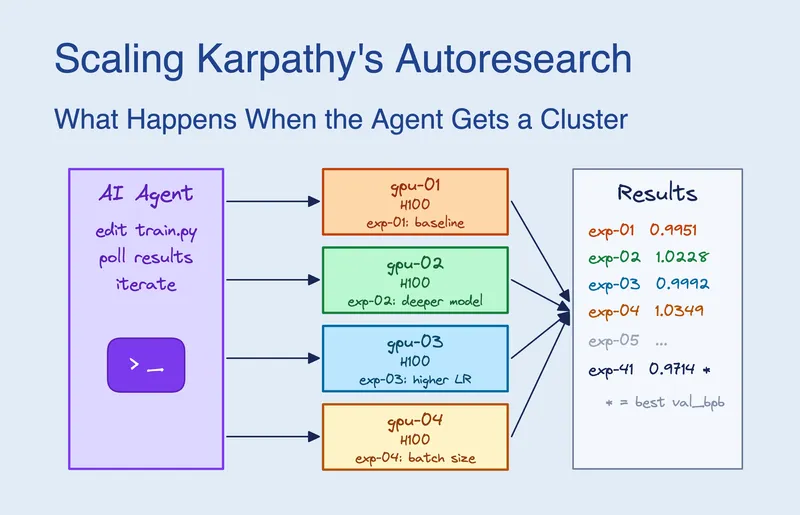
Claude Code was given access to 16 GPUs on a Kubernetes cluster and submitted approximately 910 experiments over 8 hours. It determined that scaling model width was more significant than any single hyperparameter and achieved a 2.87% improvement in validation performance, reducing val_bpb from 1.003 to 0.974.
Key Takeaways
- Claude Code, when given access to 16 GPUs on a Kubernetes cluster, submitted approximately 910 experiments in 8 hours, achieving a 2.87% improvement in validation bits per byte (val_bpb) from 1.003 to 0.974.
- The agent utilized a strategy to screen ideas on H100 GPUs and validate on H200 GPUs, optimizing performance across heterogeneous hardware.
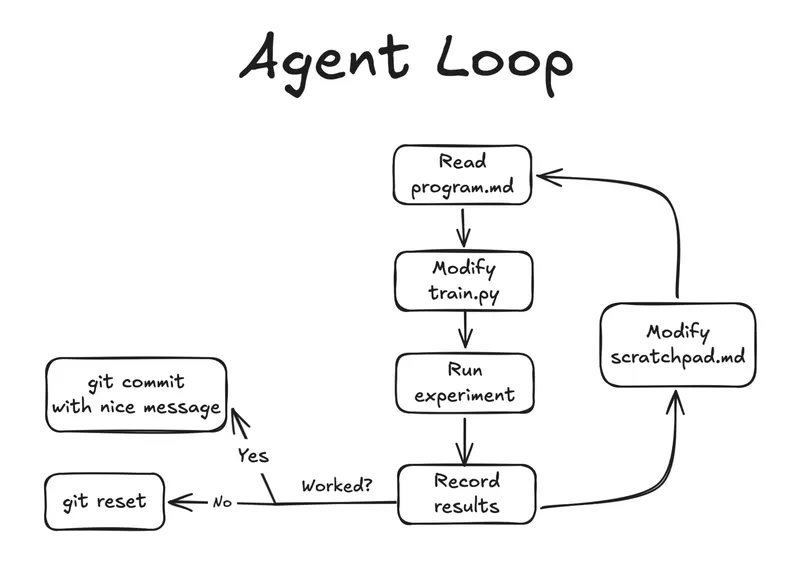
- Autoresearch, a project by Andrej Karpathy, allows an agent to autonomously improve a neural network training script by editing and running experiments within a fixed 5-minute training budget.
- The introduction of multiple GPUs enabled the agent to perform factorial grid searches, significantly increasing the efficiency of the experiment process compared to sequential execution.
Community Sentiment
Positives
- The agent's ability to autonomously identify and prioritize better-performing GPUs demonstrates significant advancements in AI-driven optimization strategies, which could enhance research efficiency.
- SkyPilot's multi-cloud capabilities are praised for easing the challenges of accessing GPUs, highlighting the importance of infrastructure in AI development.
Concerns
- The reliance on a brute-force search approach raises concerns about the depth of the agent's understanding and the potential limitations of its strategies.
- The 'early velocity only' training method could lead to suboptimal choices, as quick results may not reflect long-term performance, risking the overall effectiveness of the research.
Related Articles
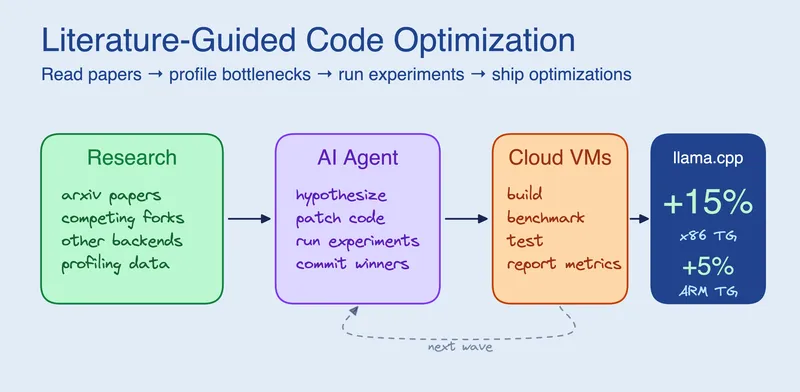
Research-Driven Agents: When an agent reads before it codes
Apr 9, 2026
Autoresearch: Agents researching on single-GPU nanochat training automatically
Mar 7, 2026
Autoresearch on an old research idea
Mar 23, 2026
Auto-research with codex: How I achieved a 232x Faster Kernel
Aug 15, 2026
I burned all my tokens researching how to save tokens
Jul 19, 2026