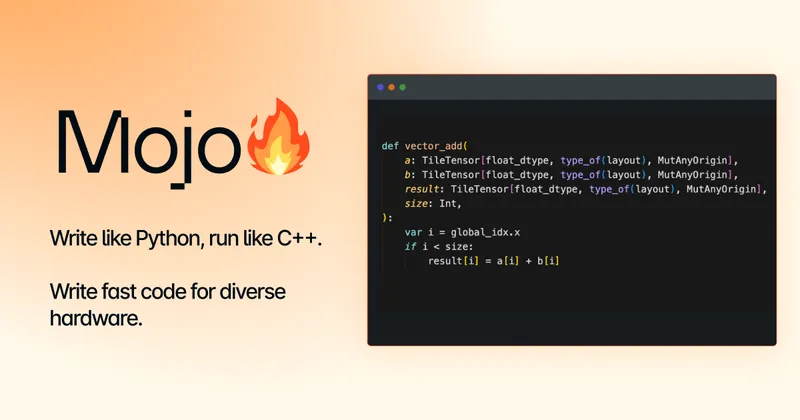
Mojo is now open source!

modular.com
August 18, 2026
3 min read
63/100
Summary
Modular has released the full source code for the Mojo programming language under the Apache 2.0 license with LLVM exceptions. The Modular GitHub repository now includes the Mojo compiler, tooling and components needed to build the language. Mojo is a general-purpose language designed to apply modern compiler and programming-language research to GPUs, AI accelerators and other advanced computing hardware. Mojo 1.0 recently reached source stability, following four years of development in which the language had an open community but a closed compiler. Modular had previously open-sourced Mojo’s standard library, kernel code, tools and support components. The Apache 2.0 license permits broad use, while the LLVM license exceptions expand permissions for building and distributing binaries compiled from Mojo. Developers can clone the Modular repository and use Bazel to build the compiler and standard library locally. The `--config=build-mojo` setting compiles the toolchain from local source, and developers can run standard-library tests through Bazel. The `--config=prebuilt-mojo` setting downloads a nightly compiler binary instead, although Modular says a prebuilt compiler remains necessary for customizing MAX kernels or models. Mojo’s standard library has accepted outside contributions since 2024, but Modular is not yet accepting contributions to the compiler or tooling and aims to do so by the end of the year.
Key Takeaways
- Modular open-sourced the Mojo compiler, tooling and related language components under the Apache 2.0 license with LLVM exceptions.
- Mojo is a general-purpose programming language built to target GPUs, AI accelerators and other advanced compute hardware.
- Mojo 1.0 recently reached source stability before Modular released the entire compiler and toolchain source code.
- The Mojo standard library has accepted contributions since 2024, while compiler and tooling contributions are planned for acceptance by the end of the year.
- Bazel can build Mojo from local source or download a nightly prebuilt compiler, which Modular says is still required for MAX kernel or model customization.
What the discussion said
The thread treated the Apache-licensed compiler release as the real test of whether Mojo can become a credible language for AI-adjacent numerical work, rather than merely an interesting proprietary experiment. Several readers said the closed compiler had been a hard stop: they would not invest in a language intended for performance-sensitive computing if they could not inspect, fork, and modify its core tooling. The license change therefore removes a major trust and adoption barrier, and some are now ready to try it for side projects and NumPy-style workloads. NuMojo was identified as the young ecosystem’s nearest equivalent to NumPy, with the clear implication that scientific-computing maturity remains a work in progress. Technical enthusiasts highlighted a compelling mix of ownership-oriented memory control, compile-time programming, type-level constraints, and LLVM-driven optimization. They see Mojo as unusually ergonomic for numerical programming compared with the sprawl of Python, C++, Rust, Julia, MATLAB, and R. Skeptics did not reject its potential, but challenged inflated descriptions of its type system and warned that absent Windows support will confine it to experienced developers on a narrow set of platforms. The licensing argument largely resolved in favor of calling the release open source: an OSI-approved Apache license grants the relevant freedoms even if the project delays accepting upstream patches.
Where opinion split
The sharp dispute was whether Mojo is genuinely open source before it accepts outside patches. One side treated contribution access as necessary for meaningful openness; the other argued that Apache 2.0 already permits use, redistribution, modification, and independent forks, while upstream governance is a separate question. The latter position carried the thread’s factual consensus.
Community Sentiment
Positives
- Apache 2.0 access clears the biggest adoption obstacle for developers who would not build AI and numerical tooling atop a proprietary compiler.
- Mojo’s ownership-aware memory model, compile-time facilities, and LLVM optimization path look promising for squeezing systems-level performance out of high-level numerical code.
- Readers see a potential escape hatch from Python-heavy scientific stacks: a language that aims to make low-level control less punishing without abandoning numerical ergonomics.
- Early NumPy-like work through NuMojo gives curious users a concrete starting point, even if the surrounding scientific ecosystem is still small.
Concerns
- Mojo’s numerical ecosystem is immature; a closest-to-NumPy package is not the same as the deep, battle-tested SciPy stack many ML and research workflows require.
- Claims about first-class dependent types drew pushback, with readers arguing the current system resembles narrower refinement-style features rather than the advertised capability.
- Without Windows support, Mojo risks remaining a specialist tool for senior developers instead of reaching the broad Python audience that dominates practical AI work.