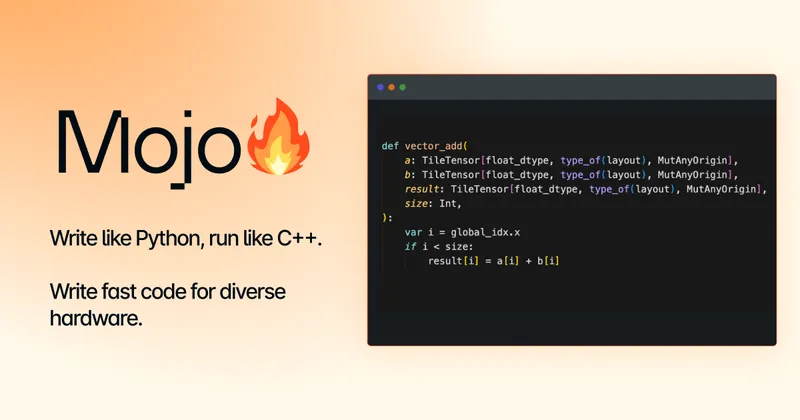
The Mojo language (by Modular, now Qualcomm) is now open-source
modular.com
August 19, 2026
7 min read
59/100
Summary
Modular announced at ModCon 2026 that Mojo 1.0 is fully open source under the Apache 2.0 license, making its compiler and tooling available for developers to extend and port to new platforms. Mojo 1.0 provides a stability guarantee intended to prevent code written against the release from breaking, and native Windows support is in development through a collaboration with Microsoft’s Windows team. Mojo previously supported macOS and Linux, while Windows users relied on WSL. Modular Cloud is now generally available through console.modular.com, offering OpenAI-compatible shared inference endpoints with pay-per-token pricing and dedicated isolated deployments. The company said the service has handled OpenRouter production traffic under the ModelRun name and serves MiniMax’s M3 model on a dedicated deployment at billions of tokens per minute. M3 combines a one-million-token context window, multimodal capabilities, and MiniMax Sparse Attention. The Modular Platform now supports AWS Trainium, Google TPUs, Qualcomm Cloud AI 100 Ultra, and Qualcomm Dragonfly accelerators, in addition to CPUs and NVIDIA and AMD GPUs. Modular said the integrations required more than 10 times less engineering effort than traditional hardware enablement. MAX will become source-available through an open alliance program, and its license no longer restricts device usage. Modular said it will continue supporting hardware that competes with Qualcomm’s platforms.
Key Takeaways
- Mojo 1.0 is fully open source under the Apache 2.0 license, including its compiler and tooling, and native Windows support is being developed with Microsoft’s Windows team.
- Modular Cloud is generally available with OpenAI-compatible shared endpoints and dedicated deployments; MiniMax uses it to serve M3 production traffic at billions of tokens per minute.
- Modular Platform supports AWS Trainium, Google TPUs, Qualcomm Cloud AI 100 Ultra, and Qualcomm Dragonfly alongside CPUs and GPUs.
- MAX no longer has device usage restrictions in its license and will become source-available as part of an ecosystem alliance program.
What the discussion said
Commenters treated the open-source release less as a language announcement than as a test of whether Mojo can still become a credible AI systems tool. The favorable case is concrete: opening the compiler removes a major adoption barrier, while Mojo’s MLIR foundation could let AI developers express high-level abstractions and still push specialized compiler optimization toward GPU code. People also pointed to prior Modular work on high-throughput LLM serving and GPU kernels, plus early enthusiasm for Python-like syntax, compile-time features, tiling, and hands-on GPU learning. Skepticism centered on traction and trust. Several readers think keeping core tooling closed during the crucial early period cost Mojo the community it needed; others question whether its performance claims are dependable, citing benchmark setups that may omit much of the actual computation. The language’s purpose also remained contested: critics see little reason for another abstraction layer when C/C++ already provide close-to-metal control, especially if coding agents reduce the value of programmer-friendly DSLs. Qualcomm’s ownership sharpened that distrust, although some argued the company is building a more open ecosystem and that open source was planned before the acquisition. Readers generally welcomed the release, but saw missing language features and a weak ecosystem as bigger practical obstacles than licensing alone.
Where opinion split
The sharpest fight is whether opening Mojo now can create real AI/compiler traction. Optimists argue that an inspectable compiler, MLIR-based optimization, and accessible GPU programming finally give developers a reason to adopt it; skeptics argue the delayed release squandered momentum and that questionable performance demonstrations leave no compelling reason to switch from established systems languages.
Community Sentiment
Positives
- Opening the compiler removes the biggest credibility barrier for an AI-oriented language, letting developers inspect, extend, and seriously evaluate its GPU toolchain.
- Its MLIR-based design could make domain-specific AI optimizations composable in libraries rather than requiring compiler-internal changes, a powerful route for high-level GPU programming.
- Earlier Modular serving and kernel work is viewed as genuinely valuable for LLM inference, with claims of strong performance against established serving stacks.
- Python-like ergonomics, compile-time programming, and tile-oriented GPU features are already making Mojo appealing as a practical way to learn accelerator programming.
Concerns
- Keeping the compiler closed during Mojo’s formative years is seen as a self-inflicted adoption wound, leaving it with little visible community traction when openness finally arrived.
- Reported performance wins face distrust because at least some benchmark kernels allegedly skip most target outputs, producing impressive throughput without equivalent useful computation.
- Critics still cannot identify a compelling AI use case over C/C++ or Rust, especially if coding agents make human-friendly DSL abstractions less valuable.
- Qualcomm ownership raises fears that the project may be harvested for its AI infrastructure assets rather than cultivated as an independent open ecosystem.