New Worlds: We are living in the future of J.G. Ballard or William Gibson
precastreinforced.co.uk
August 21, 2026
9 min read
61/100
Summary
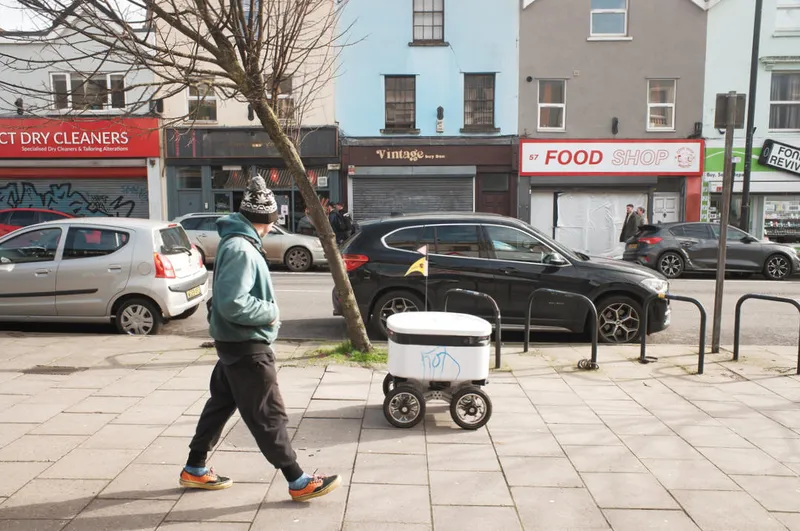
The writer characterizes everyday life in 2026 as a normalized version of cyberpunk, built from news reports, advertisements and personal encounters involving artificial intelligence, robotics, surveillance and extreme commercial ventures. Examples include Get A Drip’s IV-vitamin clinic in London’s Westfield shopping centre, a delivery robot navigating Bristol’s Gloucester Road, robots dancing at Seoul’s Galaxy Robot Park, and police drones used to identify alleged dangerous driving in Poole. The cited reports describe Meta code that Wired said added a face-recognition feature, internally called NameTag, to Meta’s AI app for use with smart glasses; banks warning that criminals use AI voice imitation for fraud; and suspicion that neo-soul performer Sienna Rose’s music is AI-generated despite 2.6 million monthly Spotify listeners. Other examples include AI-generated images of Russian soldiers circulating online, virtual “parents” offering reassurance to users in China, and workers sending AI bots to meetings. The writer argues that these developments feel less like science fiction because they appear amid ordinary routines and receive little sustained public reaction. The source also links technological normalization to climate disruption, citing wildfires affecting English Midlands housing estates and heat-related rail-track buckling, while questioning whether pausing to notice rapid change alters society’s ability to adapt to it.
Key Takeaways
- The writer presents AI, robotics, facial recognition and automated services as increasingly ordinary parts of daily life rather than distant science-fiction concepts.
- Wired reported that Meta’s AI app contained code for a smart-glasses face-recognition function called NameTag that could alert wearers when it recognized people captured by the camera.
- Banks have said AI is enabling criminals to conduct fraud at greater volume and sophistication, including by imitating the voices of celebrities, relatives and friends.
- The source describes delivery robots in Bristol, police drone operations in Dorset, robot performances in Seoul and virtual-parent videos in China as examples of automation entering public and personal life.
- The writer argues that people rapidly absorb technological and cultural changes, often treating once-startling developments as routine.
What the discussion said
The AI-related slice of the thread treated cyberpunk less as fantasy than as an increasingly ordinary description of daily life. Several readers pointed to generative art as a strikingly accurate science-fiction prediction: AI is no longer confined to calculation or command systems, but is producing images, music, and disposable cultural material. Others pushed back on the claim that this was uniquely foresighted, noting older fiction and television had already imagined machine-made novels, poetry, painting, and performance. Commenters also noticed an unresolved tension in classic AGI stories. If genuinely capable general intelligence exists, the continued presence of large white-collar workforces needs an explanation; perhaps powerful systems remain politically constrained, are repeatedly shut down, or simply fail to replace institutions as cleanly as fiction expects. Autonomous delivery drones were offered as a concrete sign that once-exotic future technology is arriving unevenly and without cyberpunk glamour. The prevailing mood was uneasy rather than celebratory: advanced AI and biotech can coexist with public irrationality, institutional incompetence, and a bland corporate visual culture. The feared future, readers suggested, is not sleek machine rule but powerful technology embedded in a messy, unaccountable social order.
Where opinion split
The sharpest dispute was whether Gibson deserves special credit for foreseeing AI-made art. Supporters see his fiction as unusually early in treating AI as a cultural creator rather than a purely logical machine; critics argue that machine-generated novels, poetry, painting, and music were already well-established science-fiction ideas.
Community Sentiment
Positives
- Generative AI making art feels like a once-speculative cyberpunk detail becoming mundane reality, broadening machines from analytical tools into cultural producers.
- Autonomous delivery drones operating in an ordinary city show that AI-enabled robotics is escaping lab demos and quietly reshaping everyday logistics.
- Classic cyberpunk’s treatment of virtual spaces and algorithmic culture now reads as practical social infrastructure rather than distant fantasy.
Concerns
- The prospect of real AGI alongside large office workforces exposes how little fiction explains the political controls, failures, and labor arrangements around powerful AI.
- Advanced AI and biotech do not automatically produce wiser societies; commenters fear capable technology is arriving amid viral nonsense and damaging public credulity.
- Readers see the emerging AI future as dystopian precisely because powerful systems are folding into opaque corporate and state power rather than serving accountable public goals.