Why your local LLM feels dumber than it is
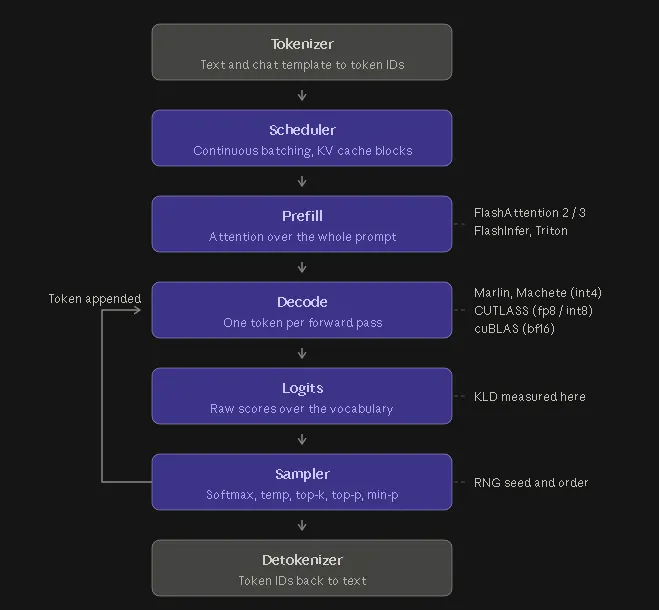
Local LLM output can diverge from a model publisher’s results because hardware, inference engines, CUDA kernels, attention backends, quantization, sampling settings, and chat templates alter next-token calculations. The post recommends workload-representative benchmarks, including long-context, tool-calling, and domain-specific evaluations, rather than a few zero-shot prompts. KL divergence can measure differences between output probability distributions, but requires disclosed reference checkpoints, runtime environments, evaluation data, context lengths, sampling positions, direction, vocabulary handling, and aggregation methods to be interpretable. Tests used Qwen3.6-27B’s official BF16 checkpoint on an RTX PRO 6000 Blackwell GPU with a roughly 100,000-token real-world tool-calling context. FlashAttention 2, FlashInfer, and Triton attention backends produced identical results early in the prompt but later disagreed on top-ranked next tokens; repeated Triton runs were bit-identical, isolating the variation to prefill matrix operations. With BF16 weights, INT8 KV-cache quantization eventually recovered from a reproducible tool-calling error, while INT4 KV-cache quantization did not. In weight-quantization tests with BF16 KV cache, a W8A16 INT8 Qwen variant showed the closest token fidelity to BF16. NVIDIA’s NVFP4 variant reached about 50% top-token flips by 88,000 tokens, and both NVFP4 and AWQ W4A16 generated incorrect Cisco commands instead of the expected "show arp" command.
forum.level1techs.com
11 min
8/22/2026
DFlash 2: Keep Drafting Parallel
Inco AI released DFlash 2, a speculative-decoding drafter that generates token blocks in parallel and is designed to raise large-language-model inference throughput without changing verified output. The company released drafters for Qwen3.8-27B and Meta’s Muse Glimmer on Hugging Face. Inco AI says DFlash 2 delivers 16% to 25% more accepted output tokens per verification pass than DFlash, with about 1.3% added draft-verify cycle latency for its combined changes. It reports 2.7× to 3.4× autoregressive-decoding throughput for Qwen3.8-27B and 3.1× to 4.6× for Muse Glimmer. DFlash 2 adds a 2 million-parameter path selector that retains 16 candidate tokens at each draft position, scores adjacent candidate pairs in parallel, and selects a more coherent sequence. It also adds 16.5 million parameters, or 3%, through dynamic two-tap depthwise convolutions that model short-range within-block dependencies and reduce declining accuracy at later token positions. Across GSM8K, MATH-500, HumanEval, MBPP, and MT-Bench, Inco AI reports a mean acceptance length of 5.97 tokens for DFlash 2, versus 4.92 for DFlash and 5.49 for DSpark under matched training setups. DFlash, released in January, is supported by SGLang, vLLM, TensorRT-LLM, and llama.cpp; Inco AI says its models had exceeded 3.5 million Hugging Face downloads as of August 2026.
inco.ai
14 min
8/19/2026
AMD acquires Taalas to boost inference performance by etching models in silicon
AMD has acquired AI chip startup Taalas to enhance inference performance by etching AI models directly into silicon. Early tech demos demonstrate that these model-specific integrated circuits can process up to 17,000 tokens per second.
theregister.com
1 min
8/6/2026
Why your local LLM feels dumber than it is
Local LLM output can diverge from a model publisher’s results because hardware, inference engines, CUDA kernels, attention backends, quantization, sampling settings, and chat templates alter next-token calculations. The post recommends workload-representative benchmarks, including long-context, tool-calling, and domain-specific evaluations, rather than a few zero-shot prompts. KL divergence can measure differences between output probability distributions, but requires disclosed reference checkpoints, runtime environments, evaluation data, context lengths, sampling positions, direction, vocabulary handling, and aggregation methods to be interpretable. Tests used Qwen3.6-27B’s official BF16 checkpoint on an RTX PRO 6000 Blackwell GPU with a roughly 100,000-token real-world tool-calling context. FlashAttention 2, FlashInfer, and Triton attention backends produced identical results early in the prompt but later disagreed on top-ranked next tokens; repeated Triton runs were bit-identical, isolating the variation to prefill matrix operations. With BF16 weights, INT8 KV-cache quantization eventually recovered from a reproducible tool-calling error, while INT4 KV-cache quantization did not. In weight-quantization tests with BF16 KV cache, a W8A16 INT8 Qwen variant showed the closest token fidelity to BF16. NVIDIA’s NVFP4 variant reached about 50% top-token flips by 88,000 tokens, and both NVFP4 and AWQ W4A16 generated incorrect Cisco commands instead of the expected "show arp" command.
forum.level1techs.com
11 min
8/22/2026
AMD acquires Taalas to boost inference performance by etching models in silicon
AMD has acquired AI chip startup Taalas to enhance inference performance by etching AI models directly into silicon. Early tech demos demonstrate that these model-specific integrated circuits can process up to 17,000 tokens per second.
theregister.com
1 min
8/6/2026
DFlash 2: Keep Drafting Parallel
Inco AI released DFlash 2, a speculative-decoding drafter that generates token blocks in parallel and is designed to raise large-language-model inference throughput without changing verified output. The company released drafters for Qwen3.8-27B and Meta’s Muse Glimmer on Hugging Face. Inco AI says DFlash 2 delivers 16% to 25% more accepted output tokens per verification pass than DFlash, with about 1.3% added draft-verify cycle latency for its combined changes. It reports 2.7× to 3.4× autoregressive-decoding throughput for Qwen3.8-27B and 3.1× to 4.6× for Muse Glimmer. DFlash 2 adds a 2 million-parameter path selector that retains 16 candidate tokens at each draft position, scores adjacent candidate pairs in parallel, and selects a more coherent sequence. It also adds 16.5 million parameters, or 3%, through dynamic two-tap depthwise convolutions that model short-range within-block dependencies and reduce declining accuracy at later token positions. Across GSM8K, MATH-500, HumanEval, MBPP, and MT-Bench, Inco AI reports a mean acceptance length of 5.97 tokens for DFlash 2, versus 4.92 for DFlash and 5.49 for DSpark under matched training setups. DFlash, released in January, is supported by SGLang, vLLM, TensorRT-LLM, and llama.cpp; Inco AI says its models had exceeded 3.5 million Hugging Face downloads as of August 2026.
inco.ai
14 min
8/19/2026
Why your local LLM feels dumber than it is
Local LLM output can diverge from a model publisher’s results because hardware, inference engines, CUDA kernels, attention backends, quantization, sampling settings, and chat templates alter next-token calculations. The post recommends workload-representative benchmarks, including long-context, tool-calling, and domain-specific evaluations, rather than a few zero-shot prompts. KL divergence can measure differences between output probability distributions, but requires disclosed reference checkpoints, runtime environments, evaluation data, context lengths, sampling positions, direction, vocabulary handling, and aggregation methods to be interpretable. Tests used Qwen3.6-27B’s official BF16 checkpoint on an RTX PRO 6000 Blackwell GPU with a roughly 100,000-token real-world tool-calling context. FlashAttention 2, FlashInfer, and Triton attention backends produced identical results early in the prompt but later disagreed on top-ranked next tokens; repeated Triton runs were bit-identical, isolating the variation to prefill matrix operations. With BF16 weights, INT8 KV-cache quantization eventually recovered from a reproducible tool-calling error, while INT4 KV-cache quantization did not. In weight-quantization tests with BF16 KV cache, a W8A16 INT8 Qwen variant showed the closest token fidelity to BF16. NVIDIA’s NVFP4 variant reached about 50% top-token flips by 88,000 tokens, and both NVFP4 and AWQ W4A16 generated incorrect Cisco commands instead of the expected "show arp" command.
forum.level1techs.com
11 min
8/22/2026
DFlash 2: Keep Drafting Parallel
Inco AI released DFlash 2, a speculative-decoding drafter that generates token blocks in parallel and is designed to raise large-language-model inference throughput without changing verified output. The company released drafters for Qwen3.8-27B and Meta’s Muse Glimmer on Hugging Face. Inco AI says DFlash 2 delivers 16% to 25% more accepted output tokens per verification pass than DFlash, with about 1.3% added draft-verify cycle latency for its combined changes. It reports 2.7× to 3.4× autoregressive-decoding throughput for Qwen3.8-27B and 3.1× to 4.6× for Muse Glimmer. DFlash 2 adds a 2 million-parameter path selector that retains 16 candidate tokens at each draft position, scores adjacent candidate pairs in parallel, and selects a more coherent sequence. It also adds 16.5 million parameters, or 3%, through dynamic two-tap depthwise convolutions that model short-range within-block dependencies and reduce declining accuracy at later token positions. Across GSM8K, MATH-500, HumanEval, MBPP, and MT-Bench, Inco AI reports a mean acceptance length of 5.97 tokens for DFlash 2, versus 4.92 for DFlash and 5.49 for DSpark under matched training setups. DFlash, released in January, is supported by SGLang, vLLM, TensorRT-LLM, and llama.cpp; Inco AI says its models had exceeded 3.5 million Hugging Face downloads as of August 2026.
inco.ai
14 min
8/19/2026
AMD acquires Taalas to boost inference performance by etching models in silicon
AMD has acquired AI chip startup Taalas to enhance inference performance by etching AI models directly into silicon. Early tech demos demonstrate that these model-specific integrated circuits can process up to 17,000 tokens per second.
theregister.com
1 min
8/6/2026
No more articles to load