Why your local LLM feels dumber than it is
forum.level1techs.com
August 22, 2026
11 min read
67/100
Summary
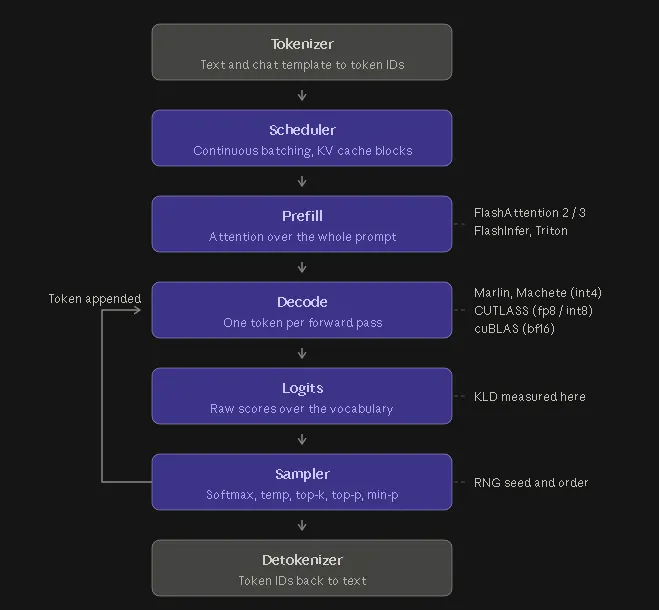
Local LLM output can diverge from a model publisher’s results because hardware, inference engines, CUDA kernels, attention backends, quantization, sampling settings, and chat templates alter next-token calculations. The post recommends workload-representative benchmarks, including long-context, tool-calling, and domain-specific evaluations, rather than a few zero-shot prompts. KL divergence can measure differences between output probability distributions, but requires disclosed reference checkpoints, runtime environments, evaluation data, context lengths, sampling positions, direction, vocabulary handling, and aggregation methods to be interpretable. Tests used Qwen3.6-27B’s official BF16 checkpoint on an RTX PRO 6000 Blackwell GPU with a roughly 100,000-token real-world tool-calling context. FlashAttention 2, FlashInfer, and Triton attention backends produced identical results early in the prompt but later disagreed on top-ranked next tokens; repeated Triton runs were bit-identical, isolating the variation to prefill matrix operations. With BF16 weights, INT8 KV-cache quantization eventually recovered from a reproducible tool-calling error, while INT4 KV-cache quantization did not. In weight-quantization tests with BF16 KV cache, a W8A16 INT8 Qwen variant showed the closest token fidelity to BF16. NVIDIA’s NVFP4 variant reached about 50% top-token flips by 88,000 tokens, and both NVFP4 and AWQ W4A16 generated incorrect Cisco commands instead of the expected "show arp" command.
Key Takeaways
- Inference hardware, software, attention kernels, quantization, sampler settings, and chat templates can change an LLM’s next-token predictions even when the underlying model weights are the same.
- FlashAttention 2, FlashInfer, and Triton attention backends began producing different highest-ranked tokens later in a roughly 100,000-token Qwen3.6-27B prompt, while repeated Triton executions were bit-identical.
- INT4 KV-cache quantization failed to recover from a reproducible tool-calling error in the Qwen3.6-27B test, while an INT8 KV cache eventually recovered.
- Among the tested weight formats with BF16 KV cache, the W8A16 INT8 Qwen3.6-27B variant had the strongest token-level fidelity to the BF16 reference.
- NVIDIA’s tested NVFP4 Qwen3.6-27B release reached roughly 50% top-token flips at 88,000 tokens and, like AWQ W4A16, produced an incorrect Cisco command in a tool-call test.
What the discussion said
The thread mostly treats supposedly dumb local models as a deployment problem, not a verdict on the underlying weights. Several commenters argue that people casually report a model as weak after running a heavily compressed GGUF, without realizing that a default Q4 build can diverge materially from BF16 behavior. Others say quantization is not even the first suspect: a missing or incorrect chat template can silently push a runtime onto a generic format, while UI sampling defaults can make comparisons with vendor or benchmark settings meaningless. Practical reports reinforce the upside. A 27B Qwen variant on Apple silicon impressed one user, while a 5090 setup reportedly delivered high token throughput, long context, and enough coding competence to build a small game. Compiling llama.cpp specifically for available hardware also reportedly doubled performance over a convenient prebuilt stack. But the discussion does not give Ollama a clean pass: critics raise both its opaque defaults and its reputation for insufficient credit to llama.cpp. One comparison also casts safety refusal as a real tradeoff, with a hosted coding model declining CTF files while an uncensored local model was allowed to attempt them. The shared lesson is that local-LLM evaluation is fragile unless the weights, prompt format, sampler, and serving stack are all disclosed.
Where opinion split
The sharpest disagreement is whether weak local results chiefly expose inferior quantized weights or broken inference configuration. One side says aggressive compression, especially an unnoticed Q4 default, is enough to make a model look far worse than its full-precision version; the other says template mismatches and inappropriate sampling settings more often sabotage otherwise capable models.
Community Sentiment
Positives
- Properly configured 27B local Qwen deployments are surprising users with capability that does not resemble the caricature of a useless on-device model.
- Hardware-aware local serving can turn the experience from a slow demo into a practical tool, with reports of doubled speed after tailored compilation and over 150 tokens per second on a 5090.
- Local uncensored models give researchers and CTF users latitude that safety-constrained hosted coding systems may refuse, preserving legitimate security-analysis workflows.
Concerns
- Default Q4 GGUF downloads can be mistaken for the model itself, so severe quantization may generate unfair claims that a capable 27B model is inherently weak.
- Silent fallback to a generic chat template can noticeably degrade instruction following while leaving the model fluent enough to hide the real failure.
- Consumer local stacks can run uncomfortably hot, making sustained laptop inference less appealing even when the model's answers impress.
- Ollama draws criticism for obscuring important deployment choices and, according to some commenters, failing to properly recognize the llama.cpp work beneath it.
Related Articles

Quantization from the Ground Up
Mar 25, 2026

Fixed three bugs that made Qwen3.5-122B a daily driver on Mac Studio
Jul 11, 2026

A 10 year old Xeon is all you need
Jun 1, 2026
Self-hosting Kimi K3: 20% more hardware cost, 20% better task resolution
Jul 29, 2026

LLM Neuroanatomy II: Modern LLM Hacking and Hints of a Universal Language?
Mar 24, 2026