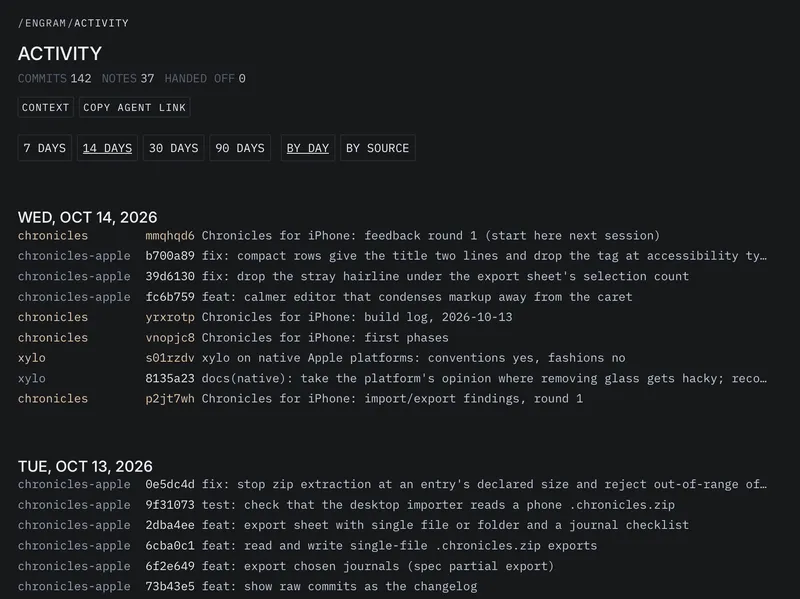
My old job feels distant now
A software developer describes moving from using ChatGPT as a search and code-generation aid to making AI agents central to daily programming work. Early uses included generating Ruby tests, finding APIs for a computer-vision project, and iterating on Python code in Jupyter notebooks. The developer says hallucinations were usually detectable at the edges of the model’s knowledge and required human investigation. Cursor-style tab completion initially provided limited pattern matching, while Claude-based agents later handled explicitly scoped tasks. The developer continued to hold the codebase context, review generated changes, and take over difficult work. They estimate that Anthropic’s Opus 4.5/6 increased their productivity to about three times its prior level over several months of merged pull requests, while also raising the importance of reviewing business logic, customer-data handling, database changes, encryption, and other irreversible operations. With Opus 5.5, the developer shifted from directing individual code changes toward defining QA goals, performance constraints, plans, dashboards, and tools for agents. They report using subagents and supervisory agents, generating multiple UI alternatives, batching vulnerability fixes, and monitoring performance. In one experiment, an AI agent produced a basic native Swift iPhone version of an Electron notes app and installed it for QA within hours, consuming 40% of a five-hour allowance on a $20 subscription.
pinecoder.dev
10 min
12h ago

What I Self-Host
A self-hosted home server built around a Beelink S12 Pro mini PC runs 28 services on an Intel N100 processor, 16 GB of RAM, a 512 GB SSD and a 6 TB media drive. The machine, bought for €180 last year, uses about 7.5 GB of memory and 30% to 40% CPU according to htop. It does not run local AI inference. Services are accessible only on the local network or through VPN; VPN endpoints run on the router and are publicly routable only over IPv6. Jellyfin replaced commercial streaming subscriptions and supplies locally controlled movies, television and home videos without autoplay or recommendation feeds. The setup also includes Immich for photo storage, Home Assistant for automation, Frigate with eight IP cameras, Vaultwarden for passwords, Actual Budget, Forgejo, FreshRSS, Audiobookshelf, Syncthing, Samba and Uptime Kuma. Frigate uses lower-resolution camera streams to limit Wi-Fi, processing and storage demands, while Jellyfin generally uses 720p media to reduce resource use. Seventeen services run natively and 11 run in Podman containers, all managed through systemd. Native deployments are preferred when dependencies are limited, while Podman is used for more complex applications. The server avoids Docker, the *arr media-management stack, self-hosted email, Collabora Online and several database-heavy alternatives because of operational complexity or resource demands.
viceconsole.fyi
16 min
1d ago

The Harness Is the Thing
Scott Fryxell describes an AI coding harness that lets Cursor, Claude, and Pi share instructions, skills, and an AGENTS.md file across terminal-based interfaces. He argues that this shared operating environment matters more than any individual model and says it has reduced his concern about switching from Cursor to Codex. His current setup uses two $20 subscriptions, Cursor and Claude, with Pi added for other models. Fryxell uses DeepSeek-V4-Flash-0731 for maintenance and simpler work, reserving frontier models and Anthropic API budget for complex features, refactors, and promotion tasks. His workflow separates work into explorer, planner, worker, critic, and promoter roles. Planning produces an explicit directed acyclic graph of tasks; a worker implements nodes, a critic reviews and may send work back for revision, and a promoter prepares communications about completed work. He says this cut his use of Fable by 75 percent in intensive work. The harness contains scripts, prompts, plans, skills, extensions, artifacts, and checked-out work repositories. It can control his poster-making web app through headless Chrome, including an npm command that generates an animation from an MP4. Fryxell says a government ban on Fable and signals of industry control made diversifying model access urgent, leading him to rely more heavily on Pi and Chinese models.
scott-fryxell.github.io
8 min
8/26/2026
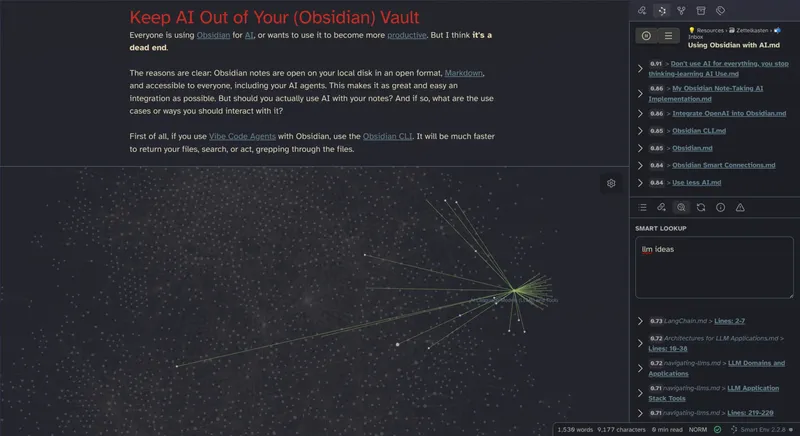
It’s so hard to finish an idea that is not yours and is just suggested by AI
Obsidian’s local, Markdown-based vaults make notes readily accessible to AI agents, but the author argues that AI-generated summaries, tags, links, and organization can weaken a personal knowledge system. Long generated summaries can make it difficult to distinguish a writer’s own ideas from AI text and add noise to later searches. The author sometimes uses Obsidian Web Clipper to create one- or two-sentence summaries, but labels them as AI-generated and removes them after adding personal writing. The author recommends AI primarily for retrieval and research, including finding related notes, vector search, similarity search, clustering, and search across large collections. Obsidian’s CLI can return files, search, and perform actions faster than grepping files when used with coding agents. The author’s single vault contains 25,979 files totaling 3.5 GB and uses the Omnisearch plugin to find material quickly; Obsidian Smart Connections can add vector and similarity search. Sensitive notes create an additional reason to prefer local models over uploads to external services. The author contends that manually writing and linking notes is part of learning and idea formation, while automated connections may produce a knowledge graph that does not reflect the user’s thinking. AI-generated material can instead be isolated in a dedicated PARA-method folder or separate vault, potentially excluded from search. The author also argues that human-curated knowledge remains valuable for both personal learning and future AI training.
ssp.sh
8 min
8/26/2026

Omarchy development practices lead to predictable security issues
HappyFellow.dev criticized Omarchy 4.0, a Linux distribution project promoted by David Heinemeier Hansson, arguing that users should not run it on machines where security matters. The post alleges that the release contained security flaws including bash injection through video titles and a notification mechanism that could allow arbitrary bash commands to run. It says these flaws stem from unsafe handling of untrusted input and from using AI-generated bash scripts to process such input without sufficient review. The author contends that starting from insecure shell scripts cannot produce a reasonably secure system through later fixes. The post acknowledges that all software projects have security vulnerabilities but argues that Omarchy’s reported issues were predictable and reflect development practices that do not prioritize security. It contrasts that view with Omarchy’s security-team announcements and recent point release, which reportedly listed numerous resolved issues. The author characterizes DHH’s promotion of Omarchy as strong marketing but says its security messaging is misleading, and predicts that some companies may prohibit its use. The stated concern is that users may underestimate the risks of installing Omarchy because the project does not, in the author’s view, clearly communicate its security limitations.
blog.happyfellow.dev
2 min
8/26/2026

Beyond Recall and the Illusion of Competence
AI-assisted programming can automate boilerplate, syntax recall, unfamiliar-library exploration and other routine implementation work, but software engineers still need to understand the systems they maintain. The source argues that code ownership has never depended on personally writing every line: developers routinely use documentation, internet searches, Stack Overflow examples, colleagues’ code and inherited services. Ownership instead depends on knowing a system’s behavior, boundaries, dependencies and failure modes. The source distinguishes delegating typing from delegating understanding. A developer who defines the required behavior and asks an AI to implement it retains control, while a developer who repeatedly submits errors and applies generated patches without understanding them may produce working software without a mental model of it. The source says debugging builds that model by requiring engineers to compare expected and observed behavior and trace where they diverge. The source warns that this risk may be greater for junior developers, whose experience traditionally develops through difficult debugging sessions. It recommends using AI aggressively for tedious coding tasks while keeping architectural decisions, system design and explanation of component interactions under human control. It predicts that as code generation becomes cheaper, architecture, integration, distributed systems, observability, failure modes, boundaries and trade-offs will become more important differentiators for developers.
var0.xyz
5 min
8/26/2026

The End of Programming
Bun 1.4 includes a rewrite of Bun from Zig to Rust, adding more than 1 million lines of Rust code. Bun creator Jarred Sumner reportedly used a pre-release model called Fable 5, an agent framework that could work in parallel, and an effectively unlimited token budget to complete the initial translation in 11 days. The effort generated 6,778 commits and would have cost about $165,000 at API pricing, according to the account. Agents then continued refining the code for months before the supported release, which Paul Dix says is running on millions of developer machines. Dix argues that AI agents will increasingly write, test and improve software while people specify requirements, build verification systems and assess end results rather than review every line of code. He reports using Fable to build unshipped InfluxDB prototypes: an Iceberg integration in 14 hours and an edge-data replication system in 28 hours, followed by testing and bug fixes. Dix says neither project is production-ready or supported, but both reached end-to-end working implementations. Dix predicts that cheaper, faster frontier models and larger token budgets could make this workflow widely accessible by the end of the following year. He expects organizational inertia to preserve manual programming and code review at many companies, while more productive teams rely on AI-directed software factories and automated verification.
pauldix.com
10 min
8/26/2026

Fences, Not Sandboxes
Steve Yegge says he runs Wheelhouse, a 50-60-agent software operation that builds and operates his long-running game Wyvern. The system uses 21 Claude Max accounts on a 512GB M3 Ultra Mac Studio, which he says represents roughly $122,000 a month in API-token value but costs him about $5,000 monthly through individual-plan discounts. Over nearly 10 weeks, Yegge says the agents helped prepare Wyvern for Android, iOS and Steam, rewrote its production infrastructure for serverless operation, and process an average of 270 commits a day. Yegge says Wheelhouse developed a text-based governance system rather than relying solely on sandboxing agents. It contains about 450 legal artifacts, including offices, runbooks, rulings, tripwires and authority envelopes. Rules can progress from customs and warnings to constitutional requirements and automated enforcement. More than 100 “fences” restrict actions based on role, credentials or policy; for example, only the Fable model is permitted to communicate externally with people through Slack and email. Yegge characterizes current models as capable but prone to poor judgment, and argues that organizations deploying large AI workforces will need to document institutional knowledge and establish evolving, machine-enforceable rules for agent coordination.
yegge.ai
17 min
8/24/2026
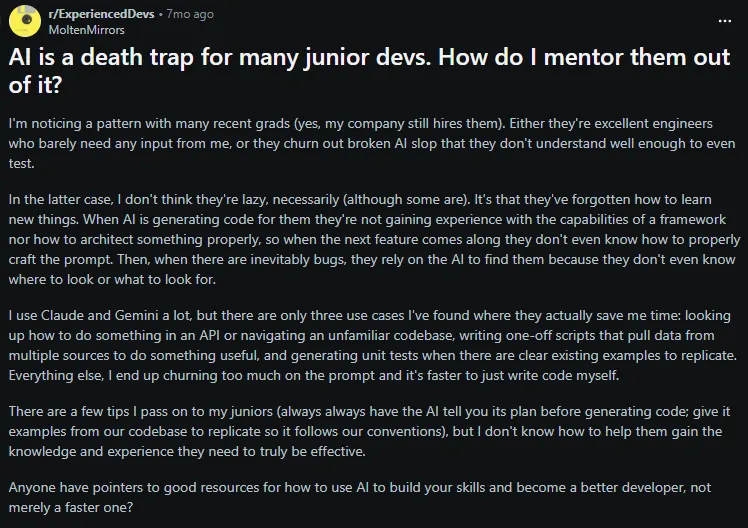
Coding expertise is going to collapse from AI reliance
Lars Faye argues that AI coding assistants can weaken the skill formation novice developers need to use those tools safely and effectively. He calls this the “expert novice” problem: developers entering the field alongside large language models are urged to use AI to keep pace, while effective prompting, code review, system design and output verification still require experience developed through repeated problem-solving. Faye says experienced engineers currently gain more from the tools because they can steer and audit their outputs. Faye cites the study “The Widening Gap: The Benefits and Harms of Generative AI for Novice Programmers,” highlighted by JetBrains, which found that participants using heavier AI assistance often skipped planning, developed an “illusion of competence,” and became lost in generated solutions. Participants who limited assistance performed better by rejecting unhelpful suggestions and using AI to accelerate solutions they already understood. He also cites a 2025 University of Pennsylvania study of 1,000 mathematics students, which reported that unrestricted LLM use led to test performance 17% below a textbook-only group, while a tutor-oriented GPT condition improved AI-assisted practice results by 127% but produced test scores similar to the textbook group. Faye recommends using LLMs primarily for interactive documentation, tutorials and Socratic exercises rather than routine code generation when learning. He says developers should verify AI outputs through official documentation, peers and hands-on testing, and distinguish delegating tedious work from delegating judgment.
larsfaye.com
13 min
8/24/2026

Agent Is Not the Model
An AI agent system combines a model, an inference service and a harness rather than consisting of the model alone. Models such as Anthropic’s Sonnet and Opus, Google’s Gemini, and OpenAI’s GPT transform input tokens into output tokens. They generally run through hosted inference services, including Anthropic’s API, AWS Bedrock and OpenAI’s infrastructure, because frontier models require substantial compute and memory. These services process API calls and track usage and pricing. The harness supplies the user-facing interface and operational logic around a model. It assembles context, defines and routes tool calls, interprets model outputs, and can interact with files or external systems. MCP servers and Skills are primarily harness-layer features: the harness determines which tools and context the model receives. Claude Desktop, Claude CLI, Cursor, ChatGPT and custom LangChain applications each pair a harness with one or more inference providers and models. The same model can produce different behavior in different agent systems because each harness shapes its prompts, available context and tools. Diagnosing problems therefore depends on identifying the relevant layer: missing context and unavailable tools usually involve the harness, slow responses involve inference infrastructure, and high cost can depend on the selected model or inference service. The source also argues that more capable models could reduce the usefulness of some current harness mechanisms, including Skills and MCP.
code.joejag.com
5 min
8/24/2026
My old job feels distant now
A software developer describes moving from using ChatGPT as a search and code-generation aid to making AI agents central to daily programming work. Early uses included generating Ruby tests, finding APIs for a computer-vision project, and iterating on Python code in Jupyter notebooks. The developer says hallucinations were usually detectable at the edges of the model’s knowledge and required human investigation. Cursor-style tab completion initially provided limited pattern matching, while Claude-based agents later handled explicitly scoped tasks. The developer continued to hold the codebase context, review generated changes, and take over difficult work. They estimate that Anthropic’s Opus 4.5/6 increased their productivity to about three times its prior level over several months of merged pull requests, while also raising the importance of reviewing business logic, customer-data handling, database changes, encryption, and other irreversible operations. With Opus 5.5, the developer shifted from directing individual code changes toward defining QA goals, performance constraints, plans, dashboards, and tools for agents. They report using subagents and supervisory agents, generating multiple UI alternatives, batching vulnerability fixes, and monitoring performance. In one experiment, an AI agent produced a basic native Swift iPhone version of an Electron notes app and installed it for QA within hours, consuming 40% of a five-hour allowance on a $20 subscription.
pinecoder.dev
10 min
12h ago
The Harness Is the Thing
Scott Fryxell describes an AI coding harness that lets Cursor, Claude, and Pi share instructions, skills, and an AGENTS.md file across terminal-based interfaces. He argues that this shared operating environment matters more than any individual model and says it has reduced his concern about switching from Cursor to Codex. His current setup uses two $20 subscriptions, Cursor and Claude, with Pi added for other models. Fryxell uses DeepSeek-V4-Flash-0731 for maintenance and simpler work, reserving frontier models and Anthropic API budget for complex features, refactors, and promotion tasks. His workflow separates work into explorer, planner, worker, critic, and promoter roles. Planning produces an explicit directed acyclic graph of tasks; a worker implements nodes, a critic reviews and may send work back for revision, and a promoter prepares communications about completed work. He says this cut his use of Fable by 75 percent in intensive work. The harness contains scripts, prompts, plans, skills, extensions, artifacts, and checked-out work repositories. It can control his poster-making web app through headless Chrome, including an npm command that generates an animation from an MP4. Fryxell says a government ban on Fable and signals of industry control made diversifying model access urgent, leading him to rely more heavily on Pi and Chinese models.
scott-fryxell.github.io
8 min
8/26/2026
Omarchy development practices lead to predictable security issues
HappyFellow.dev criticized Omarchy 4.0, a Linux distribution project promoted by David Heinemeier Hansson, arguing that users should not run it on machines where security matters. The post alleges that the release contained security flaws including bash injection through video titles and a notification mechanism that could allow arbitrary bash commands to run. It says these flaws stem from unsafe handling of untrusted input and from using AI-generated bash scripts to process such input without sufficient review. The author contends that starting from insecure shell scripts cannot produce a reasonably secure system through later fixes. The post acknowledges that all software projects have security vulnerabilities but argues that Omarchy’s reported issues were predictable and reflect development practices that do not prioritize security. It contrasts that view with Omarchy’s security-team announcements and recent point release, which reportedly listed numerous resolved issues. The author characterizes DHH’s promotion of Omarchy as strong marketing but says its security messaging is misleading, and predicts that some companies may prohibit its use. The stated concern is that users may underestimate the risks of installing Omarchy because the project does not, in the author’s view, clearly communicate its security limitations.
blog.happyfellow.dev
2 min
8/26/2026
The End of Programming
Bun 1.4 includes a rewrite of Bun from Zig to Rust, adding more than 1 million lines of Rust code. Bun creator Jarred Sumner reportedly used a pre-release model called Fable 5, an agent framework that could work in parallel, and an effectively unlimited token budget to complete the initial translation in 11 days. The effort generated 6,778 commits and would have cost about $165,000 at API pricing, according to the account. Agents then continued refining the code for months before the supported release, which Paul Dix says is running on millions of developer machines. Dix argues that AI agents will increasingly write, test and improve software while people specify requirements, build verification systems and assess end results rather than review every line of code. He reports using Fable to build unshipped InfluxDB prototypes: an Iceberg integration in 14 hours and an edge-data replication system in 28 hours, followed by testing and bug fixes. Dix says neither project is production-ready or supported, but both reached end-to-end working implementations. Dix predicts that cheaper, faster frontier models and larger token budgets could make this workflow widely accessible by the end of the following year. He expects organizational inertia to preserve manual programming and code review at many companies, while more productive teams rely on AI-directed software factories and automated verification.
pauldix.com
10 min
8/26/2026
Coding expertise is going to collapse from AI reliance
Lars Faye argues that AI coding assistants can weaken the skill formation novice developers need to use those tools safely and effectively. He calls this the “expert novice” problem: developers entering the field alongside large language models are urged to use AI to keep pace, while effective prompting, code review, system design and output verification still require experience developed through repeated problem-solving. Faye says experienced engineers currently gain more from the tools because they can steer and audit their outputs. Faye cites the study “The Widening Gap: The Benefits and Harms of Generative AI for Novice Programmers,” highlighted by JetBrains, which found that participants using heavier AI assistance often skipped planning, developed an “illusion of competence,” and became lost in generated solutions. Participants who limited assistance performed better by rejecting unhelpful suggestions and using AI to accelerate solutions they already understood. He also cites a 2025 University of Pennsylvania study of 1,000 mathematics students, which reported that unrestricted LLM use led to test performance 17% below a textbook-only group, while a tutor-oriented GPT condition improved AI-assisted practice results by 127% but produced test scores similar to the textbook group. Faye recommends using LLMs primarily for interactive documentation, tutorials and Socratic exercises rather than routine code generation when learning. He says developers should verify AI outputs through official documentation, peers and hands-on testing, and distinguish delegating tedious work from delegating judgment.
larsfaye.com
13 min
8/24/2026
What I Self-Host
A self-hosted home server built around a Beelink S12 Pro mini PC runs 28 services on an Intel N100 processor, 16 GB of RAM, a 512 GB SSD and a 6 TB media drive. The machine, bought for €180 last year, uses about 7.5 GB of memory and 30% to 40% CPU according to htop. It does not run local AI inference. Services are accessible only on the local network or through VPN; VPN endpoints run on the router and are publicly routable only over IPv6. Jellyfin replaced commercial streaming subscriptions and supplies locally controlled movies, television and home videos without autoplay or recommendation feeds. The setup also includes Immich for photo storage, Home Assistant for automation, Frigate with eight IP cameras, Vaultwarden for passwords, Actual Budget, Forgejo, FreshRSS, Audiobookshelf, Syncthing, Samba and Uptime Kuma. Frigate uses lower-resolution camera streams to limit Wi-Fi, processing and storage demands, while Jellyfin generally uses 720p media to reduce resource use. Seventeen services run natively and 11 run in Podman containers, all managed through systemd. Native deployments are preferred when dependencies are limited, while Podman is used for more complex applications. The server avoids Docker, the *arr media-management stack, self-hosted email, Collabora Online and several database-heavy alternatives because of operational complexity or resource demands.
viceconsole.fyi
16 min
1d ago
It’s so hard to finish an idea that is not yours and is just suggested by AI
Obsidian’s local, Markdown-based vaults make notes readily accessible to AI agents, but the author argues that AI-generated summaries, tags, links, and organization can weaken a personal knowledge system. Long generated summaries can make it difficult to distinguish a writer’s own ideas from AI text and add noise to later searches. The author sometimes uses Obsidian Web Clipper to create one- or two-sentence summaries, but labels them as AI-generated and removes them after adding personal writing. The author recommends AI primarily for retrieval and research, including finding related notes, vector search, similarity search, clustering, and search across large collections. Obsidian’s CLI can return files, search, and perform actions faster than grepping files when used with coding agents. The author’s single vault contains 25,979 files totaling 3.5 GB and uses the Omnisearch plugin to find material quickly; Obsidian Smart Connections can add vector and similarity search. Sensitive notes create an additional reason to prefer local models over uploads to external services. The author contends that manually writing and linking notes is part of learning and idea formation, while automated connections may produce a knowledge graph that does not reflect the user’s thinking. AI-generated material can instead be isolated in a dedicated PARA-method folder or separate vault, potentially excluded from search. The author also argues that human-curated knowledge remains valuable for both personal learning and future AI training.
ssp.sh
8 min
8/26/2026
Beyond Recall and the Illusion of Competence
AI-assisted programming can automate boilerplate, syntax recall, unfamiliar-library exploration and other routine implementation work, but software engineers still need to understand the systems they maintain. The source argues that code ownership has never depended on personally writing every line: developers routinely use documentation, internet searches, Stack Overflow examples, colleagues’ code and inherited services. Ownership instead depends on knowing a system’s behavior, boundaries, dependencies and failure modes. The source distinguishes delegating typing from delegating understanding. A developer who defines the required behavior and asks an AI to implement it retains control, while a developer who repeatedly submits errors and applies generated patches without understanding them may produce working software without a mental model of it. The source says debugging builds that model by requiring engineers to compare expected and observed behavior and trace where they diverge. The source warns that this risk may be greater for junior developers, whose experience traditionally develops through difficult debugging sessions. It recommends using AI aggressively for tedious coding tasks while keeping architectural decisions, system design and explanation of component interactions under human control. It predicts that as code generation becomes cheaper, architecture, integration, distributed systems, observability, failure modes, boundaries and trade-offs will become more important differentiators for developers.
var0.xyz
5 min
8/26/2026
Fences, Not Sandboxes
Steve Yegge says he runs Wheelhouse, a 50-60-agent software operation that builds and operates his long-running game Wyvern. The system uses 21 Claude Max accounts on a 512GB M3 Ultra Mac Studio, which he says represents roughly $122,000 a month in API-token value but costs him about $5,000 monthly through individual-plan discounts. Over nearly 10 weeks, Yegge says the agents helped prepare Wyvern for Android, iOS and Steam, rewrote its production infrastructure for serverless operation, and process an average of 270 commits a day. Yegge says Wheelhouse developed a text-based governance system rather than relying solely on sandboxing agents. It contains about 450 legal artifacts, including offices, runbooks, rulings, tripwires and authority envelopes. Rules can progress from customs and warnings to constitutional requirements and automated enforcement. More than 100 “fences” restrict actions based on role, credentials or policy; for example, only the Fable model is permitted to communicate externally with people through Slack and email. Yegge characterizes current models as capable but prone to poor judgment, and argues that organizations deploying large AI workforces will need to document institutional knowledge and establish evolving, machine-enforceable rules for agent coordination.
yegge.ai
17 min
8/24/2026
Agent Is Not the Model
An AI agent system combines a model, an inference service and a harness rather than consisting of the model alone. Models such as Anthropic’s Sonnet and Opus, Google’s Gemini, and OpenAI’s GPT transform input tokens into output tokens. They generally run through hosted inference services, including Anthropic’s API, AWS Bedrock and OpenAI’s infrastructure, because frontier models require substantial compute and memory. These services process API calls and track usage and pricing. The harness supplies the user-facing interface and operational logic around a model. It assembles context, defines and routes tool calls, interprets model outputs, and can interact with files or external systems. MCP servers and Skills are primarily harness-layer features: the harness determines which tools and context the model receives. Claude Desktop, Claude CLI, Cursor, ChatGPT and custom LangChain applications each pair a harness with one or more inference providers and models. The same model can produce different behavior in different agent systems because each harness shapes its prompts, available context and tools. Diagnosing problems therefore depends on identifying the relevant layer: missing context and unavailable tools usually involve the harness, slow responses involve inference infrastructure, and high cost can depend on the selected model or inference service. The source also argues that more capable models could reduce the usefulness of some current harness mechanisms, including Skills and MCP.
code.joejag.com
5 min
8/24/2026
My old job feels distant now
A software developer describes moving from using ChatGPT as a search and code-generation aid to making AI agents central to daily programming work. Early uses included generating Ruby tests, finding APIs for a computer-vision project, and iterating on Python code in Jupyter notebooks. The developer says hallucinations were usually detectable at the edges of the model’s knowledge and required human investigation. Cursor-style tab completion initially provided limited pattern matching, while Claude-based agents later handled explicitly scoped tasks. The developer continued to hold the codebase context, review generated changes, and take over difficult work. They estimate that Anthropic’s Opus 4.5/6 increased their productivity to about three times its prior level over several months of merged pull requests, while also raising the importance of reviewing business logic, customer-data handling, database changes, encryption, and other irreversible operations. With Opus 5.5, the developer shifted from directing individual code changes toward defining QA goals, performance constraints, plans, dashboards, and tools for agents. They report using subagents and supervisory agents, generating multiple UI alternatives, batching vulnerability fixes, and monitoring performance. In one experiment, an AI agent produced a basic native Swift iPhone version of an Electron notes app and installed it for QA within hours, consuming 40% of a five-hour allowance on a $20 subscription.
pinecoder.dev
10 min
12h ago
It’s so hard to finish an idea that is not yours and is just suggested by AI
Obsidian’s local, Markdown-based vaults make notes readily accessible to AI agents, but the author argues that AI-generated summaries, tags, links, and organization can weaken a personal knowledge system. Long generated summaries can make it difficult to distinguish a writer’s own ideas from AI text and add noise to later searches. The author sometimes uses Obsidian Web Clipper to create one- or two-sentence summaries, but labels them as AI-generated and removes them after adding personal writing. The author recommends AI primarily for retrieval and research, including finding related notes, vector search, similarity search, clustering, and search across large collections. Obsidian’s CLI can return files, search, and perform actions faster than grepping files when used with coding agents. The author’s single vault contains 25,979 files totaling 3.5 GB and uses the Omnisearch plugin to find material quickly; Obsidian Smart Connections can add vector and similarity search. Sensitive notes create an additional reason to prefer local models over uploads to external services. The author contends that manually writing and linking notes is part of learning and idea formation, while automated connections may produce a knowledge graph that does not reflect the user’s thinking. AI-generated material can instead be isolated in a dedicated PARA-method folder or separate vault, potentially excluded from search. The author also argues that human-curated knowledge remains valuable for both personal learning and future AI training.
ssp.sh
8 min
8/26/2026
The End of Programming
Bun 1.4 includes a rewrite of Bun from Zig to Rust, adding more than 1 million lines of Rust code. Bun creator Jarred Sumner reportedly used a pre-release model called Fable 5, an agent framework that could work in parallel, and an effectively unlimited token budget to complete the initial translation in 11 days. The effort generated 6,778 commits and would have cost about $165,000 at API pricing, according to the account. Agents then continued refining the code for months before the supported release, which Paul Dix says is running on millions of developer machines. Dix argues that AI agents will increasingly write, test and improve software while people specify requirements, build verification systems and assess end results rather than review every line of code. He reports using Fable to build unshipped InfluxDB prototypes: an Iceberg integration in 14 hours and an edge-data replication system in 28 hours, followed by testing and bug fixes. Dix says neither project is production-ready or supported, but both reached end-to-end working implementations. Dix predicts that cheaper, faster frontier models and larger token budgets could make this workflow widely accessible by the end of the following year. He expects organizational inertia to preserve manual programming and code review at many companies, while more productive teams rely on AI-directed software factories and automated verification.
pauldix.com
10 min
8/26/2026
Agent Is Not the Model
An AI agent system combines a model, an inference service and a harness rather than consisting of the model alone. Models such as Anthropic’s Sonnet and Opus, Google’s Gemini, and OpenAI’s GPT transform input tokens into output tokens. They generally run through hosted inference services, including Anthropic’s API, AWS Bedrock and OpenAI’s infrastructure, because frontier models require substantial compute and memory. These services process API calls and track usage and pricing. The harness supplies the user-facing interface and operational logic around a model. It assembles context, defines and routes tool calls, interprets model outputs, and can interact with files or external systems. MCP servers and Skills are primarily harness-layer features: the harness determines which tools and context the model receives. Claude Desktop, Claude CLI, Cursor, ChatGPT and custom LangChain applications each pair a harness with one or more inference providers and models. The same model can produce different behavior in different agent systems because each harness shapes its prompts, available context and tools. Diagnosing problems therefore depends on identifying the relevant layer: missing context and unavailable tools usually involve the harness, slow responses involve inference infrastructure, and high cost can depend on the selected model or inference service. The source also argues that more capable models could reduce the usefulness of some current harness mechanisms, including Skills and MCP.
code.joejag.com
5 min
8/24/2026
What I Self-Host
A self-hosted home server built around a Beelink S12 Pro mini PC runs 28 services on an Intel N100 processor, 16 GB of RAM, a 512 GB SSD and a 6 TB media drive. The machine, bought for €180 last year, uses about 7.5 GB of memory and 30% to 40% CPU according to htop. It does not run local AI inference. Services are accessible only on the local network or through VPN; VPN endpoints run on the router and are publicly routable only over IPv6. Jellyfin replaced commercial streaming subscriptions and supplies locally controlled movies, television and home videos without autoplay or recommendation feeds. The setup also includes Immich for photo storage, Home Assistant for automation, Frigate with eight IP cameras, Vaultwarden for passwords, Actual Budget, Forgejo, FreshRSS, Audiobookshelf, Syncthing, Samba and Uptime Kuma. Frigate uses lower-resolution camera streams to limit Wi-Fi, processing and storage demands, while Jellyfin generally uses 720p media to reduce resource use. Seventeen services run natively and 11 run in Podman containers, all managed through systemd. Native deployments are preferred when dependencies are limited, while Podman is used for more complex applications. The server avoids Docker, the *arr media-management stack, self-hosted email, Collabora Online and several database-heavy alternatives because of operational complexity or resource demands.
viceconsole.fyi
16 min
1d ago
Omarchy development practices lead to predictable security issues
HappyFellow.dev criticized Omarchy 4.0, a Linux distribution project promoted by David Heinemeier Hansson, arguing that users should not run it on machines where security matters. The post alleges that the release contained security flaws including bash injection through video titles and a notification mechanism that could allow arbitrary bash commands to run. It says these flaws stem from unsafe handling of untrusted input and from using AI-generated bash scripts to process such input without sufficient review. The author contends that starting from insecure shell scripts cannot produce a reasonably secure system through later fixes. The post acknowledges that all software projects have security vulnerabilities but argues that Omarchy’s reported issues were predictable and reflect development practices that do not prioritize security. It contrasts that view with Omarchy’s security-team announcements and recent point release, which reportedly listed numerous resolved issues. The author characterizes DHH’s promotion of Omarchy as strong marketing but says its security messaging is misleading, and predicts that some companies may prohibit its use. The stated concern is that users may underestimate the risks of installing Omarchy because the project does not, in the author’s view, clearly communicate its security limitations.
blog.happyfellow.dev
2 min
8/26/2026
Fences, Not Sandboxes
Steve Yegge says he runs Wheelhouse, a 50-60-agent software operation that builds and operates his long-running game Wyvern. The system uses 21 Claude Max accounts on a 512GB M3 Ultra Mac Studio, which he says represents roughly $122,000 a month in API-token value but costs him about $5,000 monthly through individual-plan discounts. Over nearly 10 weeks, Yegge says the agents helped prepare Wyvern for Android, iOS and Steam, rewrote its production infrastructure for serverless operation, and process an average of 270 commits a day. Yegge says Wheelhouse developed a text-based governance system rather than relying solely on sandboxing agents. It contains about 450 legal artifacts, including offices, runbooks, rulings, tripwires and authority envelopes. Rules can progress from customs and warnings to constitutional requirements and automated enforcement. More than 100 “fences” restrict actions based on role, credentials or policy; for example, only the Fable model is permitted to communicate externally with people through Slack and email. Yegge characterizes current models as capable but prone to poor judgment, and argues that organizations deploying large AI workforces will need to document institutional knowledge and establish evolving, machine-enforceable rules for agent coordination.
yegge.ai
17 min
8/24/2026
The Harness Is the Thing
Scott Fryxell describes an AI coding harness that lets Cursor, Claude, and Pi share instructions, skills, and an AGENTS.md file across terminal-based interfaces. He argues that this shared operating environment matters more than any individual model and says it has reduced his concern about switching from Cursor to Codex. His current setup uses two $20 subscriptions, Cursor and Claude, with Pi added for other models. Fryxell uses DeepSeek-V4-Flash-0731 for maintenance and simpler work, reserving frontier models and Anthropic API budget for complex features, refactors, and promotion tasks. His workflow separates work into explorer, planner, worker, critic, and promoter roles. Planning produces an explicit directed acyclic graph of tasks; a worker implements nodes, a critic reviews and may send work back for revision, and a promoter prepares communications about completed work. He says this cut his use of Fable by 75 percent in intensive work. The harness contains scripts, prompts, plans, skills, extensions, artifacts, and checked-out work repositories. It can control his poster-making web app through headless Chrome, including an npm command that generates an animation from an MP4. Fryxell says a government ban on Fable and signals of industry control made diversifying model access urgent, leading him to rely more heavily on Pi and Chinese models.
scott-fryxell.github.io
8 min
8/26/2026
Beyond Recall and the Illusion of Competence
AI-assisted programming can automate boilerplate, syntax recall, unfamiliar-library exploration and other routine implementation work, but software engineers still need to understand the systems they maintain. The source argues that code ownership has never depended on personally writing every line: developers routinely use documentation, internet searches, Stack Overflow examples, colleagues’ code and inherited services. Ownership instead depends on knowing a system’s behavior, boundaries, dependencies and failure modes. The source distinguishes delegating typing from delegating understanding. A developer who defines the required behavior and asks an AI to implement it retains control, while a developer who repeatedly submits errors and applies generated patches without understanding them may produce working software without a mental model of it. The source says debugging builds that model by requiring engineers to compare expected and observed behavior and trace where they diverge. The source warns that this risk may be greater for junior developers, whose experience traditionally develops through difficult debugging sessions. It recommends using AI aggressively for tedious coding tasks while keeping architectural decisions, system design and explanation of component interactions under human control. It predicts that as code generation becomes cheaper, architecture, integration, distributed systems, observability, failure modes, boundaries and trade-offs will become more important differentiators for developers.
var0.xyz
5 min
8/26/2026
Coding expertise is going to collapse from AI reliance
Lars Faye argues that AI coding assistants can weaken the skill formation novice developers need to use those tools safely and effectively. He calls this the “expert novice” problem: developers entering the field alongside large language models are urged to use AI to keep pace, while effective prompting, code review, system design and output verification still require experience developed through repeated problem-solving. Faye says experienced engineers currently gain more from the tools because they can steer and audit their outputs. Faye cites the study “The Widening Gap: The Benefits and Harms of Generative AI for Novice Programmers,” highlighted by JetBrains, which found that participants using heavier AI assistance often skipped planning, developed an “illusion of competence,” and became lost in generated solutions. Participants who limited assistance performed better by rejecting unhelpful suggestions and using AI to accelerate solutions they already understood. He also cites a 2025 University of Pennsylvania study of 1,000 mathematics students, which reported that unrestricted LLM use led to test performance 17% below a textbook-only group, while a tutor-oriented GPT condition improved AI-assisted practice results by 127% but produced test scores similar to the textbook group. Faye recommends using LLMs primarily for interactive documentation, tutorials and Socratic exercises rather than routine code generation when learning. He says developers should verify AI outputs through official documentation, peers and hands-on testing, and distinguish delegating tedious work from delegating judgment.
larsfaye.com
13 min
8/24/2026