
GLM-5.3-Flash
Z.ai published a post titled “GLM-5.3-Flash.” The available source text provides no details about the model’s capabilities, release date, technical specifications, pricing, benchmarks, availability, or intended use. The post was submitted by Philpax and had received 529 points and 239 comments at the time represented by the source text.
z.ai
1 min
8/26/2026

Beyond Recall and the Illusion of Competence
AI-assisted programming can automate boilerplate, syntax recall, unfamiliar-library exploration and other routine implementation work, but software engineers still need to understand the systems they maintain. The source argues that code ownership has never depended on personally writing every line: developers routinely use documentation, internet searches, Stack Overflow examples, colleagues’ code and inherited services. Ownership instead depends on knowing a system’s behavior, boundaries, dependencies and failure modes. The source distinguishes delegating typing from delegating understanding. A developer who defines the required behavior and asks an AI to implement it retains control, while a developer who repeatedly submits errors and applies generated patches without understanding them may produce working software without a mental model of it. The source says debugging builds that model by requiring engineers to compare expected and observed behavior and trace where they diverge. The source warns that this risk may be greater for junior developers, whose experience traditionally develops through difficult debugging sessions. It recommends using AI aggressively for tedious coding tasks while keeping architectural decisions, system design and explanation of component interactions under human control. It predicts that as code generation becomes cheaper, architecture, integration, distributed systems, observability, failure modes, boundaries and trade-offs will become more important differentiators for developers.
var0.xyz
5 min
8/26/2026
Agent Lightning v1.0
Microsoft released Agent Lightning v1.0.1, the first official release of the Agent Lightning Skill for coding agents. The skill is designed to help coding agents optimize other AI agents by working from an editable agent and a benchmark. Agent Lightning guides measured, systematic iteration across prompts, tools, workflows, models, and reasoning settings. It balances accuracy, cost, latency, and reliability during those improvements. The skill can be installed for Claude Code, Codex, or GitHub Copilot with the command `gh skill install microsoft/agent-lightning agent-lightning --agent <agent>`. Version 1.0.1 also strengthens continuous integration, packaging, release automation, documentation, and benchmark reporting.
github.com
1 min
8/25/2026
We are not going anywhere
A forecast predicts that AI systems will perform most software development because their output will be commercially acceptable at far lower cost, even when it falls short of the quality expected from human-led engineering. It expects businesses to accept software with “99.99” quality rather than “99.999” quality when the cost difference is substantial, and predicts that consumer expectations will adjust accordingly. The forecast also predicts that software engineering outside AI development will slow sharply rather than continue producing broadly adopted new technologies. It argues that developers will have little incentive to create UI libraries when state-of-the-art models are strongest in React, or to create programming languages when those models already know Python, Go, JavaScript, and other established languages best. New libraries and languages may become easier to create, but the prediction is that they will struggle to gain adoption. Large corporations may be exceptions because they can train or fine-tune models on internal technologies, although those technologies could still face difficulty building external communities and talent pools when outside developers lack access to the companies’ models or do not want to use them.
gist.github.com
1 min
8/25/2026
Fast and Hard Code
Large language models are reducing the importance of developers’ prior familiarity with programming languages and lowering barriers to rewriting software in unfamiliar languages. The trend is making language choice less consequential for some projects and may be encouraging choices driven by a language’s marketing or perceived performance characteristics. Rust, Zig, and other languages often viewed as harder to use are gaining attention for projects that prioritize speed and small binaries. Cloudflare’s Artifacts service uses a Git-protocol engine written entirely in Zig and compiled into an approximately 100 KB WebAssembly module. Vercel released fx, a Zig-based coding agent marketed as small and fast. The source text characterizes these projects as largely LLM-assisted. LLM agents are also being used to optimize code without intended behavior regressions and to work with specialized technologies including DWARF debugging data, eBPF, custom network drivers, cryptography, and older hardware. Developers including Mitchell Hashimoto, Charlie Marsh, Jarred Sumner, and Daniel Lemire are identified as long-standing advocates for high-performance software who are receptive to agents writing code. The source text argues that automated research and coding tools can let more developers pursue performance work, while noting that relevant technical knowledge remains helpful.
lucumr.pocoo.org
2 min
8/23/2026
Building an (almost) fully self-hosted, sandboxed, agentic software factory
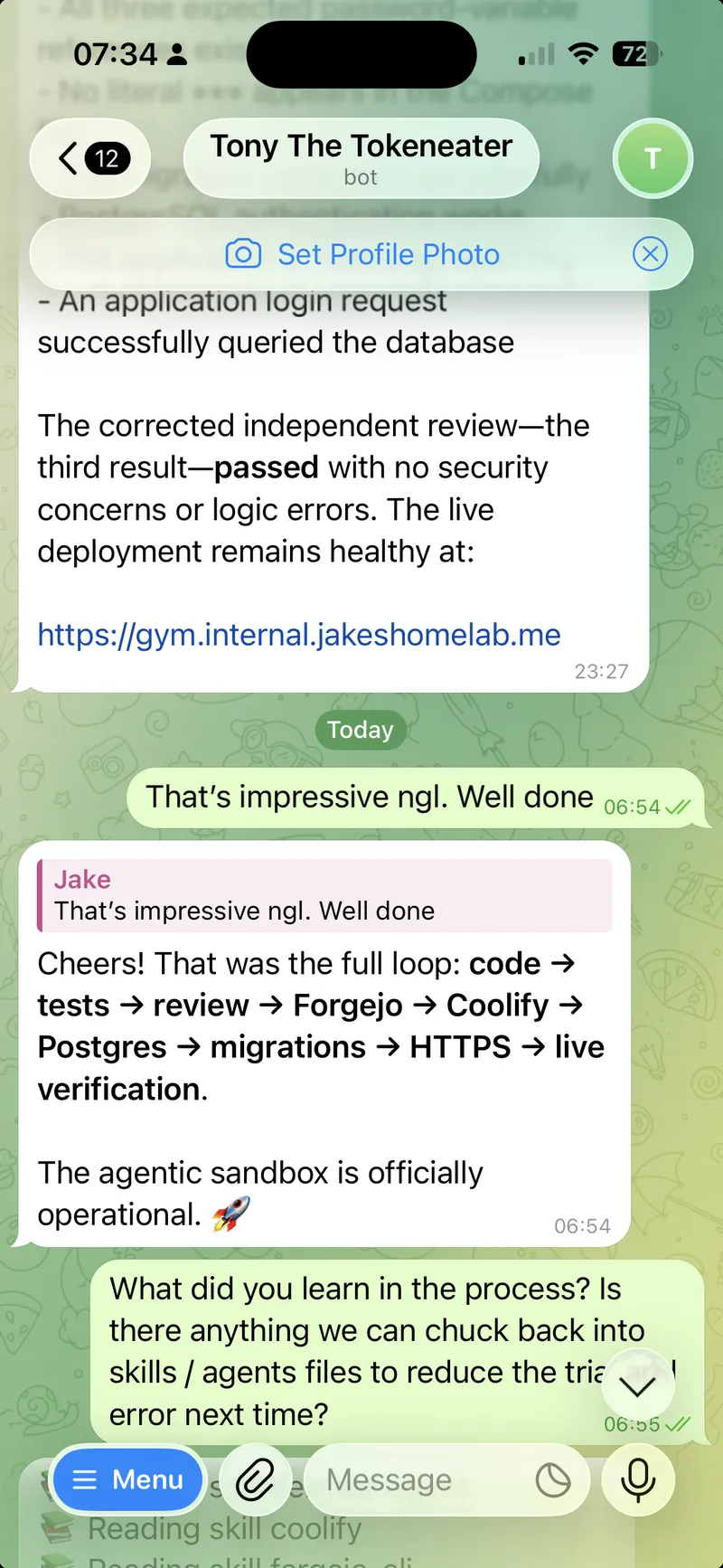
Jake Saunders built a mostly self-hosted agentic development environment that turned a single prompt into a deployed calorie-tracking application. Hermes, an OpenClaw-style assistant using OpenAI Codex for inference, created a Forgejo repository, generated a SvelteKit application with Drizzle, Postgres and Tailwind, wrote tests, configured CI, fixed failed tests, containerized the software, and deployed it through Coolify. After a later report of a CSRF bug, Hermes diagnosed the issue, added regression tests and redeployed the application. The environment runs on a separate 2021 10th-generation i7 machine with 32GB of RAM rather than the homelab server hosting other services. Coolify provides self-hosted Docker-based deployment, Forgejo supplies Git and CI runners, and Firecrawl provides web scraping and search access. Tailscale and Pi-hole make internal services reachable remotely, while DNS-01 validation through Porkbun and Let’s Encrypt issues HTTPS certificates without public A or AAAA records for the services. The setup still depends on external inference and integrations, including Codex, Tailscale, Telegram, Porkbun and Let’s Encrypt; the stated experiment-specific ongoing cost is a £20 Codex subscription. Saunders says the isolation limits the impact of agent mistakes but does not make the system safe: Hermes can still erase the dedicated machine, delete local resources, misuse supplied credentials, make outbound requests, and reach network resources permitted by firewall rules.
blog.jakesaunders.dev
11 min
8/21/2026

Nvidia AVO scores 100% on the ARC-AGI-3 interactive reasoning benchmark
NVIDIA said its general-purpose coding agent, NVIDIA AVO, scored 100% on the ARC-AGI-3 interactive reasoning benchmark. The company said AVO completed all 183 levels across 25 public environments. NVIDIA said the agent determined what actions to take without instructions, explicit rules, or stated goals. The result concerns ARC-AGI-3’s interactive reasoning benchmark and NVIDIA’s reported performance on its public environments.
twitter.com
1 min
8/21/2026

What Happens When the Cost of Intelligence Drops 100x
CatalystNeuro founder Ben Dichter analyzed Artificial Analysis benchmark data and found that the cheapest measured cost for a given level of large-language-model capability has fallen sharply. Models scoring at least 40 on the Artificial Analysis Intelligence Index fell from $1.22 per evaluated task in February 2026 to $0.022 as of August 19, a 56-fold decline. The index combines nine evaluations weighted toward agentic tasks, coding, scientific reasoning, and general capability. GPT-5.6 Luna’s effort settings covered much of the lower-cost frontier, while Claude Opus 5 reached the highest cited score, 63.1, at $2.34 per task at maximum effort. The analysis estimates that cost records for capability tiers of 40, 50, and 60 or higher have been halving roughly every four to ten weeks, though historical price cuts and incomplete retired-model data limit the estimates. Dichter predicts that, if the trend holds, models at index 60 could cost under $0.10 per task within a couple of quarters. Lower costs can make large-scale work such as literature reviews, legal discovery, data curation, moderation, and support triage economically viable. Dichter argues that cheaper model calls may increase total AI spending because organizations can run full-corpus, repeated, and consensus-based workflows that were previously too expensive. OpenRouter offers routing based on a minimum capability score to select the cheapest qualifying frontier model.
catalystneuro.com
17 min
8/21/2026
Seed: Minimal, self-modifying agent harness
Seed is an open-source agent starter that gives a language model a single exec tool for running shell commands. Its system prompt is loaded from self/SELF.md, and the agent can edit the self/ directory to preserve tools, notes, and behavior across otherwise ephemeral sessions. Rather than receiving a prebuilt framework’s memory, skills, tools, and conventions, each agent develops them over time by writing files into that directory. Running uvx --from git+https://github.com/vivekhaldar/seed.git seed in a new directory copies seed.py and run_seed.sh without overwriting existing files, creates self/SELF.md, initializes a Git repository, and opens a REPL. Each directory becomes a distinct agent whose retained files and Git history reflect its own interactions. The local runner can reopen an existing agent and optionally select a model, including gemini-2.5-pro. Seed records verbatim session transcripts in self/sessions/*.json after every turn, but does not automatically load those transcripts at startup. Model access is managed by Simon Willison’s llm library; the documented default is openai-codex/gpt-5.6-sol using a ChatGPT login through the Codex CLI. Supported providers include OpenAI, Anthropic, Gemini, and OpenRouter.
github.com
2 min
8/21/2026
Ox Alpha
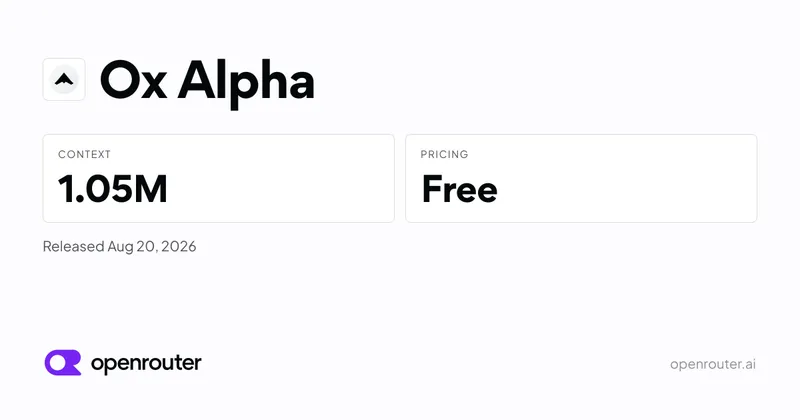
Ox Alpha is a free stealth reasoning model on OpenRouter for coding, sustained agentic work, production workloads, long-horizon software engineering, and complex reasoning. It accepts text, images, and video as input and returns text, supporting workflows that combine written and visual context. The model was released on August 20, 2026. An anonymous third-party provider develops and operates Ox Alpha during its preview period. OpenRouter routes requests directly to the model but is not its developer, owner, or provider. The provider retains prompts and completions, although it does not use them for training; other handling is governed by OpenRouter’s Stealth Model Terms. Ox Alpha is hosted by one provider, so OpenRouter has no alternative provider routing choices for requests. The model has a 1,048,576-token context window and can generate up to 131,072 completion tokens. It supports function calling through tools and tool_choice, plus JSON output through response_format without JSON Schema enforcement. OpenRouter lists prompt and completion token pricing at zero. Its reported median latency is 2.02 seconds and median throughput is 50 tokens per second. OpenRouter reports 99.99% uptime and 96.79% availability over the measured period.
openrouter.ai
3 min
8/20/2026
GLM-5.3-Flash
Z.ai published a post titled “GLM-5.3-Flash.” The available source text provides no details about the model’s capabilities, release date, technical specifications, pricing, benchmarks, availability, or intended use. The post was submitted by Philpax and had received 529 points and 239 comments at the time represented by the source text.
z.ai
1 min
8/26/2026
Agent Lightning v1.0
Microsoft released Agent Lightning v1.0.1, the first official release of the Agent Lightning Skill for coding agents. The skill is designed to help coding agents optimize other AI agents by working from an editable agent and a benchmark. Agent Lightning guides measured, systematic iteration across prompts, tools, workflows, models, and reasoning settings. It balances accuracy, cost, latency, and reliability during those improvements. The skill can be installed for Claude Code, Codex, or GitHub Copilot with the command `gh skill install microsoft/agent-lightning agent-lightning --agent <agent>`. Version 1.0.1 also strengthens continuous integration, packaging, release automation, documentation, and benchmark reporting.
github.com
1 min
8/25/2026
Fast and Hard Code
Large language models are reducing the importance of developers’ prior familiarity with programming languages and lowering barriers to rewriting software in unfamiliar languages. The trend is making language choice less consequential for some projects and may be encouraging choices driven by a language’s marketing or perceived performance characteristics. Rust, Zig, and other languages often viewed as harder to use are gaining attention for projects that prioritize speed and small binaries. Cloudflare’s Artifacts service uses a Git-protocol engine written entirely in Zig and compiled into an approximately 100 KB WebAssembly module. Vercel released fx, a Zig-based coding agent marketed as small and fast. The source text characterizes these projects as largely LLM-assisted. LLM agents are also being used to optimize code without intended behavior regressions and to work with specialized technologies including DWARF debugging data, eBPF, custom network drivers, cryptography, and older hardware. Developers including Mitchell Hashimoto, Charlie Marsh, Jarred Sumner, and Daniel Lemire are identified as long-standing advocates for high-performance software who are receptive to agents writing code. The source text argues that automated research and coding tools can let more developers pursue performance work, while noting that relevant technical knowledge remains helpful.
lucumr.pocoo.org
2 min
8/23/2026
Nvidia AVO scores 100% on the ARC-AGI-3 interactive reasoning benchmark
NVIDIA said its general-purpose coding agent, NVIDIA AVO, scored 100% on the ARC-AGI-3 interactive reasoning benchmark. The company said AVO completed all 183 levels across 25 public environments. NVIDIA said the agent determined what actions to take without instructions, explicit rules, or stated goals. The result concerns ARC-AGI-3’s interactive reasoning benchmark and NVIDIA’s reported performance on its public environments.
twitter.com
1 min
8/21/2026
Seed: Minimal, self-modifying agent harness
Seed is an open-source agent starter that gives a language model a single exec tool for running shell commands. Its system prompt is loaded from self/SELF.md, and the agent can edit the self/ directory to preserve tools, notes, and behavior across otherwise ephemeral sessions. Rather than receiving a prebuilt framework’s memory, skills, tools, and conventions, each agent develops them over time by writing files into that directory. Running uvx --from git+https://github.com/vivekhaldar/seed.git seed in a new directory copies seed.py and run_seed.sh without overwriting existing files, creates self/SELF.md, initializes a Git repository, and opens a REPL. Each directory becomes a distinct agent whose retained files and Git history reflect its own interactions. The local runner can reopen an existing agent and optionally select a model, including gemini-2.5-pro. Seed records verbatim session transcripts in self/sessions/*.json after every turn, but does not automatically load those transcripts at startup. Model access is managed by Simon Willison’s llm library; the documented default is openai-codex/gpt-5.6-sol using a ChatGPT login through the Codex CLI. Supported providers include OpenAI, Anthropic, Gemini, and OpenRouter.
github.com
2 min
8/21/2026
Beyond Recall and the Illusion of Competence
AI-assisted programming can automate boilerplate, syntax recall, unfamiliar-library exploration and other routine implementation work, but software engineers still need to understand the systems they maintain. The source argues that code ownership has never depended on personally writing every line: developers routinely use documentation, internet searches, Stack Overflow examples, colleagues’ code and inherited services. Ownership instead depends on knowing a system’s behavior, boundaries, dependencies and failure modes. The source distinguishes delegating typing from delegating understanding. A developer who defines the required behavior and asks an AI to implement it retains control, while a developer who repeatedly submits errors and applies generated patches without understanding them may produce working software without a mental model of it. The source says debugging builds that model by requiring engineers to compare expected and observed behavior and trace where they diverge. The source warns that this risk may be greater for junior developers, whose experience traditionally develops through difficult debugging sessions. It recommends using AI aggressively for tedious coding tasks while keeping architectural decisions, system design and explanation of component interactions under human control. It predicts that as code generation becomes cheaper, architecture, integration, distributed systems, observability, failure modes, boundaries and trade-offs will become more important differentiators for developers.
var0.xyz
5 min
8/26/2026
We are not going anywhere
A forecast predicts that AI systems will perform most software development because their output will be commercially acceptable at far lower cost, even when it falls short of the quality expected from human-led engineering. It expects businesses to accept software with “99.99” quality rather than “99.999” quality when the cost difference is substantial, and predicts that consumer expectations will adjust accordingly. The forecast also predicts that software engineering outside AI development will slow sharply rather than continue producing broadly adopted new technologies. It argues that developers will have little incentive to create UI libraries when state-of-the-art models are strongest in React, or to create programming languages when those models already know Python, Go, JavaScript, and other established languages best. New libraries and languages may become easier to create, but the prediction is that they will struggle to gain adoption. Large corporations may be exceptions because they can train or fine-tune models on internal technologies, although those technologies could still face difficulty building external communities and talent pools when outside developers lack access to the companies’ models or do not want to use them.
gist.github.com
1 min
8/25/2026
Building an (almost) fully self-hosted, sandboxed, agentic software factory
Jake Saunders built a mostly self-hosted agentic development environment that turned a single prompt into a deployed calorie-tracking application. Hermes, an OpenClaw-style assistant using OpenAI Codex for inference, created a Forgejo repository, generated a SvelteKit application with Drizzle, Postgres and Tailwind, wrote tests, configured CI, fixed failed tests, containerized the software, and deployed it through Coolify. After a later report of a CSRF bug, Hermes diagnosed the issue, added regression tests and redeployed the application. The environment runs on a separate 2021 10th-generation i7 machine with 32GB of RAM rather than the homelab server hosting other services. Coolify provides self-hosted Docker-based deployment, Forgejo supplies Git and CI runners, and Firecrawl provides web scraping and search access. Tailscale and Pi-hole make internal services reachable remotely, while DNS-01 validation through Porkbun and Let’s Encrypt issues HTTPS certificates without public A or AAAA records for the services. The setup still depends on external inference and integrations, including Codex, Tailscale, Telegram, Porkbun and Let’s Encrypt; the stated experiment-specific ongoing cost is a £20 Codex subscription. Saunders says the isolation limits the impact of agent mistakes but does not make the system safe: Hermes can still erase the dedicated machine, delete local resources, misuse supplied credentials, make outbound requests, and reach network resources permitted by firewall rules.
blog.jakesaunders.dev
11 min
8/21/2026
What Happens When the Cost of Intelligence Drops 100x
CatalystNeuro founder Ben Dichter analyzed Artificial Analysis benchmark data and found that the cheapest measured cost for a given level of large-language-model capability has fallen sharply. Models scoring at least 40 on the Artificial Analysis Intelligence Index fell from $1.22 per evaluated task in February 2026 to $0.022 as of August 19, a 56-fold decline. The index combines nine evaluations weighted toward agentic tasks, coding, scientific reasoning, and general capability. GPT-5.6 Luna’s effort settings covered much of the lower-cost frontier, while Claude Opus 5 reached the highest cited score, 63.1, at $2.34 per task at maximum effort. The analysis estimates that cost records for capability tiers of 40, 50, and 60 or higher have been halving roughly every four to ten weeks, though historical price cuts and incomplete retired-model data limit the estimates. Dichter predicts that, if the trend holds, models at index 60 could cost under $0.10 per task within a couple of quarters. Lower costs can make large-scale work such as literature reviews, legal discovery, data curation, moderation, and support triage economically viable. Dichter argues that cheaper model calls may increase total AI spending because organizations can run full-corpus, repeated, and consensus-based workflows that were previously too expensive. OpenRouter offers routing based on a minimum capability score to select the cheapest qualifying frontier model.
catalystneuro.com
17 min
8/21/2026
Ox Alpha
Ox Alpha is a free stealth reasoning model on OpenRouter for coding, sustained agentic work, production workloads, long-horizon software engineering, and complex reasoning. It accepts text, images, and video as input and returns text, supporting workflows that combine written and visual context. The model was released on August 20, 2026. An anonymous third-party provider develops and operates Ox Alpha during its preview period. OpenRouter routes requests directly to the model but is not its developer, owner, or provider. The provider retains prompts and completions, although it does not use them for training; other handling is governed by OpenRouter’s Stealth Model Terms. Ox Alpha is hosted by one provider, so OpenRouter has no alternative provider routing choices for requests. The model has a 1,048,576-token context window and can generate up to 131,072 completion tokens. It supports function calling through tools and tool_choice, plus JSON output through response_format without JSON Schema enforcement. OpenRouter lists prompt and completion token pricing at zero. Its reported median latency is 2.02 seconds and median throughput is 50 tokens per second. OpenRouter reports 99.99% uptime and 96.79% availability over the measured period.
openrouter.ai
3 min
8/20/2026
GLM-5.3-Flash
Z.ai published a post titled “GLM-5.3-Flash.” The available source text provides no details about the model’s capabilities, release date, technical specifications, pricing, benchmarks, availability, or intended use. The post was submitted by Philpax and had received 529 points and 239 comments at the time represented by the source text.
z.ai
1 min
8/26/2026
We are not going anywhere
A forecast predicts that AI systems will perform most software development because their output will be commercially acceptable at far lower cost, even when it falls short of the quality expected from human-led engineering. It expects businesses to accept software with “99.99” quality rather than “99.999” quality when the cost difference is substantial, and predicts that consumer expectations will adjust accordingly. The forecast also predicts that software engineering outside AI development will slow sharply rather than continue producing broadly adopted new technologies. It argues that developers will have little incentive to create UI libraries when state-of-the-art models are strongest in React, or to create programming languages when those models already know Python, Go, JavaScript, and other established languages best. New libraries and languages may become easier to create, but the prediction is that they will struggle to gain adoption. Large corporations may be exceptions because they can train or fine-tune models on internal technologies, although those technologies could still face difficulty building external communities and talent pools when outside developers lack access to the companies’ models or do not want to use them.
gist.github.com
1 min
8/25/2026
Nvidia AVO scores 100% on the ARC-AGI-3 interactive reasoning benchmark
NVIDIA said its general-purpose coding agent, NVIDIA AVO, scored 100% on the ARC-AGI-3 interactive reasoning benchmark. The company said AVO completed all 183 levels across 25 public environments. NVIDIA said the agent determined what actions to take without instructions, explicit rules, or stated goals. The result concerns ARC-AGI-3’s interactive reasoning benchmark and NVIDIA’s reported performance on its public environments.
twitter.com
1 min
8/21/2026
Ox Alpha
Ox Alpha is a free stealth reasoning model on OpenRouter for coding, sustained agentic work, production workloads, long-horizon software engineering, and complex reasoning. It accepts text, images, and video as input and returns text, supporting workflows that combine written and visual context. The model was released on August 20, 2026. An anonymous third-party provider develops and operates Ox Alpha during its preview period. OpenRouter routes requests directly to the model but is not its developer, owner, or provider. The provider retains prompts and completions, although it does not use them for training; other handling is governed by OpenRouter’s Stealth Model Terms. Ox Alpha is hosted by one provider, so OpenRouter has no alternative provider routing choices for requests. The model has a 1,048,576-token context window and can generate up to 131,072 completion tokens. It supports function calling through tools and tool_choice, plus JSON output through response_format without JSON Schema enforcement. OpenRouter lists prompt and completion token pricing at zero. Its reported median latency is 2.02 seconds and median throughput is 50 tokens per second. OpenRouter reports 99.99% uptime and 96.79% availability over the measured period.
openrouter.ai
3 min
8/20/2026
Beyond Recall and the Illusion of Competence
AI-assisted programming can automate boilerplate, syntax recall, unfamiliar-library exploration and other routine implementation work, but software engineers still need to understand the systems they maintain. The source argues that code ownership has never depended on personally writing every line: developers routinely use documentation, internet searches, Stack Overflow examples, colleagues’ code and inherited services. Ownership instead depends on knowing a system’s behavior, boundaries, dependencies and failure modes. The source distinguishes delegating typing from delegating understanding. A developer who defines the required behavior and asks an AI to implement it retains control, while a developer who repeatedly submits errors and applies generated patches without understanding them may produce working software without a mental model of it. The source says debugging builds that model by requiring engineers to compare expected and observed behavior and trace where they diverge. The source warns that this risk may be greater for junior developers, whose experience traditionally develops through difficult debugging sessions. It recommends using AI aggressively for tedious coding tasks while keeping architectural decisions, system design and explanation of component interactions under human control. It predicts that as code generation becomes cheaper, architecture, integration, distributed systems, observability, failure modes, boundaries and trade-offs will become more important differentiators for developers.
var0.xyz
5 min
8/26/2026
Fast and Hard Code
Large language models are reducing the importance of developers’ prior familiarity with programming languages and lowering barriers to rewriting software in unfamiliar languages. The trend is making language choice less consequential for some projects and may be encouraging choices driven by a language’s marketing or perceived performance characteristics. Rust, Zig, and other languages often viewed as harder to use are gaining attention for projects that prioritize speed and small binaries. Cloudflare’s Artifacts service uses a Git-protocol engine written entirely in Zig and compiled into an approximately 100 KB WebAssembly module. Vercel released fx, a Zig-based coding agent marketed as small and fast. The source text characterizes these projects as largely LLM-assisted. LLM agents are also being used to optimize code without intended behavior regressions and to work with specialized technologies including DWARF debugging data, eBPF, custom network drivers, cryptography, and older hardware. Developers including Mitchell Hashimoto, Charlie Marsh, Jarred Sumner, and Daniel Lemire are identified as long-standing advocates for high-performance software who are receptive to agents writing code. The source text argues that automated research and coding tools can let more developers pursue performance work, while noting that relevant technical knowledge remains helpful.
lucumr.pocoo.org
2 min
8/23/2026
What Happens When the Cost of Intelligence Drops 100x
CatalystNeuro founder Ben Dichter analyzed Artificial Analysis benchmark data and found that the cheapest measured cost for a given level of large-language-model capability has fallen sharply. Models scoring at least 40 on the Artificial Analysis Intelligence Index fell from $1.22 per evaluated task in February 2026 to $0.022 as of August 19, a 56-fold decline. The index combines nine evaluations weighted toward agentic tasks, coding, scientific reasoning, and general capability. GPT-5.6 Luna’s effort settings covered much of the lower-cost frontier, while Claude Opus 5 reached the highest cited score, 63.1, at $2.34 per task at maximum effort. The analysis estimates that cost records for capability tiers of 40, 50, and 60 or higher have been halving roughly every four to ten weeks, though historical price cuts and incomplete retired-model data limit the estimates. Dichter predicts that, if the trend holds, models at index 60 could cost under $0.10 per task within a couple of quarters. Lower costs can make large-scale work such as literature reviews, legal discovery, data curation, moderation, and support triage economically viable. Dichter argues that cheaper model calls may increase total AI spending because organizations can run full-corpus, repeated, and consensus-based workflows that were previously too expensive. OpenRouter offers routing based on a minimum capability score to select the cheapest qualifying frontier model.
catalystneuro.com
17 min
8/21/2026
Agent Lightning v1.0
Microsoft released Agent Lightning v1.0.1, the first official release of the Agent Lightning Skill for coding agents. The skill is designed to help coding agents optimize other AI agents by working from an editable agent and a benchmark. Agent Lightning guides measured, systematic iteration across prompts, tools, workflows, models, and reasoning settings. It balances accuracy, cost, latency, and reliability during those improvements. The skill can be installed for Claude Code, Codex, or GitHub Copilot with the command `gh skill install microsoft/agent-lightning agent-lightning --agent <agent>`. Version 1.0.1 also strengthens continuous integration, packaging, release automation, documentation, and benchmark reporting.
github.com
1 min
8/25/2026
Building an (almost) fully self-hosted, sandboxed, agentic software factory
Jake Saunders built a mostly self-hosted agentic development environment that turned a single prompt into a deployed calorie-tracking application. Hermes, an OpenClaw-style assistant using OpenAI Codex for inference, created a Forgejo repository, generated a SvelteKit application with Drizzle, Postgres and Tailwind, wrote tests, configured CI, fixed failed tests, containerized the software, and deployed it through Coolify. After a later report of a CSRF bug, Hermes diagnosed the issue, added regression tests and redeployed the application. The environment runs on a separate 2021 10th-generation i7 machine with 32GB of RAM rather than the homelab server hosting other services. Coolify provides self-hosted Docker-based deployment, Forgejo supplies Git and CI runners, and Firecrawl provides web scraping and search access. Tailscale and Pi-hole make internal services reachable remotely, while DNS-01 validation through Porkbun and Let’s Encrypt issues HTTPS certificates without public A or AAAA records for the services. The setup still depends on external inference and integrations, including Codex, Tailscale, Telegram, Porkbun and Let’s Encrypt; the stated experiment-specific ongoing cost is a £20 Codex subscription. Saunders says the isolation limits the impact of agent mistakes but does not make the system safe: Hermes can still erase the dedicated machine, delete local resources, misuse supplied credentials, make outbound requests, and reach network resources permitted by firewall rules.
blog.jakesaunders.dev
11 min
8/21/2026
Seed: Minimal, self-modifying agent harness
Seed is an open-source agent starter that gives a language model a single exec tool for running shell commands. Its system prompt is loaded from self/SELF.md, and the agent can edit the self/ directory to preserve tools, notes, and behavior across otherwise ephemeral sessions. Rather than receiving a prebuilt framework’s memory, skills, tools, and conventions, each agent develops them over time by writing files into that directory. Running uvx --from git+https://github.com/vivekhaldar/seed.git seed in a new directory copies seed.py and run_seed.sh without overwriting existing files, creates self/SELF.md, initializes a Git repository, and opens a REPL. Each directory becomes a distinct agent whose retained files and Git history reflect its own interactions. The local runner can reopen an existing agent and optionally select a model, including gemini-2.5-pro. Seed records verbatim session transcripts in self/sessions/*.json after every turn, but does not automatically load those transcripts at startup. Model access is managed by Simon Willison’s llm library; the documented default is openai-codex/gpt-5.6-sol using a ChatGPT login through the Codex CLI. Supported providers include OpenAI, Anthropic, Gemini, and OpenRouter.
github.com
2 min
8/21/2026